| Women Soldiers: The Historical Record |
|
Joshua S. Goldstein
More information about War and Gender is available at
www.warandgender.com
For the References cited in footnotes, click here
Abstract
The question of women soldiers has generated substantial historical research, but of mixed quality. This paper -- from a chapter of War and Gender: How Gender Shapes the War System and Vice Versa (Cambridge, 2001) -- comprehensively reviews the historical performance of women combatants in war, across history and cultures.
Women's participation in combat, although rare, demonstrates potential capability roughly equal to men's – though women on average may fight less well than men. Women have proven to be capable fighters in female combat units, in mixed-gender units, as individuals in groups of men, and as leaders of male armies.
Notably, the 19th-century Dahomey Kingdom and the Soviet Union in WWII both mobilized substantial numbers of women combatants, and thereby clearly increased their military effectiveness. Yet these successes were not copied elsewhere. Domestic political structures and ideologies appear central to the Dahomey and Soviet deployments of women soldiers. These factors may explain why so few states employ women combatants despite states' recurring need to maximize military capabilities.
INTRODUCTION
The question of women combatants has generated substantial historical research in recent years, sparked by feminist scholarship’s interest in uncovering the previously ignored roles of women in social and political history. Several accounts chronicle the role of individual women soldiers in a variety of societies and time periods. Historian Linda Grant De Pauw writes, “Women have always and everywhere been inextricably involved in war, [but] hidden from history…. During wars, women are ubiquitous and highly visible; when wars are over and the war songs are sung, women disappear.”1
Unfortunately, several recent overviews mix well-documented cases with legends, so the subject requires some sorting out. In particular, John Laffin’s 1967 Women in Battle contains almost no documentation, and the caveat that the stories therein were “difficult to acquire and even more difficult to verify.” (Laffin’s own opinion is that a “woman’s place should be in the bed and not the battlefield.”) Yet Laffin’s stories turn up as fact in Jessica Amanda Salmonson’s 1991 Encyclopedia of Amazons – a confusing mix of historical and mythical cases – and David Jones’s 1997 Women Warriors, among others. Linda Grant De Pauw is more reliable and provides good documentation on US and European history, despite accepting too uncritically some unsupported claims concerning prehistory, anthropology, and non-Western countries. De Pauw groups women’s roles in war into four categories: (1) the classic roles of victim and of instigator; (2) combat support roles; (3) “virago” roles that perform masculine functions without changing feminine appearance (such as warrior queens, women members of home militias, or all-female combat units); and (4) warrior roles in which women become like men, often changing clothing and other gender markers.2
The evidence on women soldiers and that on women political leaders in wartime seems to support liberal feminists; women can perform these roles effectively. I review women’s participation in each of several settings in turn – female combat units, mixed-gender units, individual women in groups of men, and women military leaders of male armies.
| |
| A. FEMALE COMBAT UNITS |
Is it workable to organize sizable military combat units with only female participants? The answer is a qualified yes – it has been tried only a handful of times in all of history, but the results show the possibility of success, defined as strengthening the military’s effectiveness in war. These cases, although few, demonstrate the possibility of effective women combatants.
Dahomey in the slave-trading era
The eighteenth- and nineteenth-century Dahomey Kingdom of West Africa (present-day Benin) is the only documented case of a large-scale female combat unit that functioned over a long period as part of a standing army. The Dahomey Kingdom arose in the late sixteenth century when an aggressive clan conquered its neighbors and expanded its territory. The economy of Dahomey was fundamentally based on the slave trade – go to war against neighboring societies to capture slaves; trade the slaves to Europeans for guns; use the guns to go to war. Interwoven with these wars were extreme acts of large-scale human sacrifice, torture, and cannibalism, practiced on prisoners captured in war. Dahomey was one of the most successful military organizations ever in its region, and was rightly feared by its neighbors. It grew up with the slave trade – which expanded after 1670 and eventually exported 2 million people from the area – and ended when France conquered it in 1892, at the end of the slaving era. The kings of Dahomey enjoyed showing off the Amazon corps to visiting Europeans (Dahomey’s slave-export customers) who were always interested in the phenomenon, and thus we have direct reports from English visitors in 1793, 1847, and 1851. Stanley Alpern has documented the case well.3
The “Amazon corps” appears to have originated in 1727 when Dahomey faced a grave military situation. King Agadja armed a regiment of females at the rear, apparently just to make his forces appear larger, and discovered that they actually fought well. Subsequently, the king organized the Amazon corps as a kind of palace guard. The corps’ size, which varied over time and is in some dispute, apparently ranged from about 800 women early in the nineteenth century to over 5,000 at the mid-century peak, several thousand being combat forces. Women comprised a substantial minority of the Dahomean army, varying from under one-tenth to over one-third of the total. Some of the women were native-born, while others were captured in war and showed surprising loyalty. In one instance, a girl who had been captured young and raised in Dahomey was recaptured while fighting in the Amazon corps but refused to go back to her parents, insisting on returning to Dahomey instead.4
The women soldiers were armed with muskets and swords. They drilled regularly and resembled the men in dress and activities (see Figure 2.1). They stayed in top physical condition and were fast and strong. In the field, the Amazon corps carried mats and bedding on their heads, along with powder, shot, and food for a week or two. Some writers describe the women as rather large and strong. However, this physique is common to the other countries of West Africa, none of which used women as soldiers.5

Figure 2.1 Dahomean Amazon, as drawn by English visitor, 1850. [Forbes 1851, plate 2. Smithsonian Institution Libraries. © Frank Cass & Co.]
The women showed at least as much courage as the men – more, by several accounts – and had a reputation for cruelty. There was no known case of women warriors fleeing combat, although men often did so. One European observer concluded that, “if undertaking a campaign, I should prefer the females to the male soldiers.”6
The women of the Amazon corps said: “We are men, not women!… Our nature is changed.” They dressed, ate, and behaved as the men did. The Amazon corps members were technically married to the King (but did not have sex with him), were extremely loyal to him, and were forbidden to have sex with men (at the risk of death for both, although some observers thought the rule was frequently broken anyway). Several thousand lived in the palace, along with civilian wives (perhaps 2,000 of them) and female slaves. According to one report, female prostitutes were employed in the palace to serve the Amazon corps, although this is unclear. The Amazon corps was totally segregated from men. Outside the palace, its approach was announced by a ringing bell. Everyone had to turn their backs, and males had to move away.7
The Dahomean army was not primarily female. Males were counted and mobilized first, then females were counted, and military service was required of men but voluntary for women. A village could send women in place of men who did not want to serve. The army was divided into two parts, the left and the right, and each was in turn divided into a male and female component – a division which somewhat reflected the organization of Dahomey political administration.8
Although not in the majority, the women soldiers played a key role in the Dahomey army, and performed admirably in combat. In a battle in 1840, an enemy force routed the male Dahomean soldiers and only a rally of the Amazon corps prevented disaster. Using female soldiers had some drawbacks, however. In 1851, 10,000 males and 6,000 females faced 15,000 defenders in a neighboring society. The defenders were “infuriated” by the discovery – as they were preparing to castrate a prisoner of war – that some of the Dahomean soldiers were women. They redoubled their efforts, with their own women acting as supply troops, and repulsed the Dahomey attack with 2,000 to 3,000 Dahomey killed. In 1890–92, France conquered Dahomey, but it required several bloody attempts (showing that Dahomey was the strongest military power in West Africa at the time). In the first major battle, in 1890, Dahomey women soldiers took part and several were found dead on the battlefield, to the surprise of the French soldiers. In a later battle, the French commander noted that the Amazon corps, about 2,000 strong, led the attack in the presence of the king and showed remarkable speed and boldness.9
Dahomey probably turned to women soldiers in part because, unlike its neighbors, it faced a severe military manpower shortage for three reasons. It was exceptionally warlike and lost men in war. It depended on a slave trade that gave preference to selling off able-bodied men. And it faced a hostile neighbor ten times larger than itself. Firearms had only recently been introduced to the region, but this does not explain the Amazons (by equalizing men’s and women’s strength) as Marvin Harris claims. Although muskets were basic weapons, they were crude and often ineffective. A machete-like sword was decisive. Women effectively used this and a variety of weapons including daggers, bayonets, battle-axes, bows and arrows, clubs, and a giant folding razor (with a blade over 2 feet long) apparently used mainly for decapitation but possibly for castrating enemies as well.10
Dahomey is a critical case because it shows that women can be physically and emotionally capable of participating in war on a large-scale, long-term, and well-organized basis. Far from being weakened by the participation of women, the army of Dahomey was clearly strengthened. Women soldiers helped make Dahomey the preeminent regional military power that it became in the nineteenth century. Yet Dahomey is virtually the only case of its kind. The puzzle is why this successful case was not emulated elsewhere.11
The Soviet Union in World War II
Among modern great-power armies, the most substantial participation of women in combat has occurred in the Soviet Union during World War II. Following a rapid, forced industrialization of the Soviet economy in the 1930s under Stalin, in which women were drawn into nontraditional labor roles, the Soviet Union faced a dire emergency when it was invaded by Nazi Germany in 1941. Over the next three years, the Soviets would count tens of millions of war dead, and large parts of their country would be left in ruins. In this extreme situation, the Soviet Union mobilized every possible resource for the war effort, eventually including women for combat duty. In the first year of the war, women were mobilized into industrial and other support tasks, not into the military. These tasks included those women were already doing – they were already 40 percent of the industrial labor force at the outset – as well as new occupations that had been all male, such as mining. Women also dug trenches and built fortifications for the Soviet military.12
Beginning in 1942, faced with manpower shortages, the Soviet Union drafted into the military childless women not already employed in war work. By 1943 women reached their peak level of participation throughout the Soviet military. Their main areas of involvement were in medical specialties (especially nursing) – these were often front-line positions – and antiaircraft units which “became virtually a feminized military specialty.”13
Clearly, hundreds of thousands of women participated in the Soviet military during World War II. However, sources “are distressingly vague” on the actual number. The official figures state that about 800,000 women participated in the Red Army and about another 200,000 in partisan (irregular) forces. These figures put women at about 8 percent of overall forces (with 12 million men). Of the total of 800,000, about 500,000 reportedly served at the front, and about 250,000 received military training in Komsomol schools. Most were in their late teens.14
All the information regarding Soviet women’s participation in World War II comes to us through “a mass of hyperbolic and patriotic press accounts and memoirs.” Playing up the contributions of women helped the formidable Soviet propaganda machine to raise morale in a dispirited population, and spur greater sacrifices by the male soldiers. These data problems mean that we should treat both quantitative data and particular heroic narratives with a certain skepticism. The “majority of women did not serve in direct combat.”15
Despite all that, clearly women participated on a substantial scale – hundreds of thousands of individuals, a nontrivial minority of the total forces. Even if we reduce the extent and heroism of female participation from the official version, we are left with an important historic case of large-scale women’s participation in combat – probably the largest such case in modern history.
The overriding impression left by the case is that women performed a very wide range of combat tasks and “proved themselves” in those tasks, eventually gaining the “acceptance and even admiration” of Soviet military men who had been “initially skeptical or hostile.” I will summarize each of the main areas in which women took part, in rough order of the importance of female participation to that area – front-line medical support, antiaircraft, combat aviation, partisan forces, infantry, and armor.16
Medical support tasks in the Soviet military were integrated with combat to an unusual degree. Doctors and nurses served at the front lines under intense fire. All nurses and over 40 percent of doctors in the Soviet military were women. Many of the heroic stories about these women – some of which appear to be true even if some are exaggerated – revolve around their actions in dragging and carrying wounded male soldiers to safety on the battlefield, sometimes by the dozen. In other cases, women medical soldiers joined and even commanded infantry units when the male ranks were decimated. Reportedly, Vera Krylova enlisted as a student nurse in 1941, was sent to the front, and dragged hundreds of wounded comrades to safety under fire. When her isolated unit was ambushed and its leaders killed, in the chaos of the German advance of August 1941, the wounded Krylova jumped on a horse, took command of the company, and led a two-week battle through encircling enemy forces to rejoin Russian forces. The next year, fighting with a different unit which was retreating from a tank battle, Krylova moved forward to collect hand grenades from wounded comrades being left behind, then single-handedly charged the German tanks with grenades, slowing the advance enough for the Russians to evacuate their wounded. Such tales, although not verifiable in particular cases, reflect an overall reality – that many thousands of Soviet women served as front-line medical workers and some also participated directly (and effectively) in combat.17
Antiaircraft units were staffed and commanded entirely by women – apparently hundreds of thousands in all. (British forces in World War II included women in antiaircraft units but had men fire the guns. US home-territory antiaircraft defense, though not needed in the end, also relied on women.) One German pilot is quoted as saying that he would rather fly ten times over hostile Libya than “pass once through the fire of Russian flak sent up by female gunners.” One reason cited for the women’s success was that, in these all-female military units, a “military female subculture” emerged which did its work in a warmer and more casual way than in men’s units.18
In the Soviet air force, three women’s regiments were formed – a small fraction of the total force but a useful test of all-female combat units. The women pilots were organized by Marina Raskova, a kind of Amelia Earhart celebrity in the Soviet Union in the 1930s, who was flooded with offers by women pilots to volunteer in World War II. She convinced Stalin of their potential value in the war effort, and went on to organize the regiments and lead one of them until her death (at age 31) in a crash en route to their first deployment in 1943.19
The most famous was the 588th Night Bomber Air Regiment (46th Guards Bomber Regiment), sometimes called the “night witches.” It had over 4,000 members, and at its peak carried out hundreds of sorties per night (officially, 24,000 missions in all). These pilots flew cheap, combustible biplanes (see Figure 2.2) – often unarmed, sometimes armed with a light machine-gun in back, to drop bombs on German positions at night (they could not have survived in daytime). They suffered substantial losses. Although the plane could land almost anywhere, the crew did not have parachutes, so a fire was often fatal. At dusk the women would fly from a rear base to a temporary airfield near the front, then send one plane every three minutes out to and back from the target all night long, with each plane completing up to three missions in one night. The system provided the Germans with no rest at night, but also let them anticipate the arrival of a plane and catch it in spotlights, making it an easy target. The pilots learned to slip-slide out of the spotlights and make their bombing runs with engines turned off until after they had dropped their six to eight bombs. Especially in winter, when nights were longest, “[t]he women – pilots and ground crews alike – lived on the verge of physical collapse, managing a bit of sleep or a meal whenever they could.”20

Figure 2.2 Soviet night-bomber flown by women pilots, World War II. [Photo by Yevgeny Khaldei, courtesy of Anne Noggle.]
The unit was the only truly all-female one – not only pilots and navigators but also most of the ground crew (e.g., mechanics and bomb-loaders) were women. (The other two regiments were commanded by males who replaced the original women leaders, when Raskova died and another commander was recalled for ill health. The appointment of male commanders seems to have been an expedient measure under time pressure to get the regiments into service.) The night bomber regiment was famous during the war, receiving extensive domestic and international press.
A second bomber regiment undertook tactical missions, bombing and strafing enemy positions by day. Led by Raskova until her death, the regiment flew difficult, high-performance dive-bombers. Some of the ground crew, and some tail-gunners, were men, but all the pilots and navigators were women. Unlike the night bombers, this regiment received very little publicity during the war and operated under virtually the same conditions as the equivalent male bomber regiments. The commander said: “During the war there was no difference between this regiment and any male regiments. We lived in dugouts, as did the other regiments, and flew on the same missions, not more or less dangerous.”21
The third regiment was an interceptor unit (the 586th). Also commanded by a man, it eventually incorporated a male squadron (ten planes) to join the two female squadrons. Some of the ground crew were men, mainly because the sophisticated aircraft required skills beyond the rudimentary training of most women mechanics at that time. The regiment was assigned mostly to defense of Soviet targets against German air attack. Its role was to drive away attacking planes rather than pursue them. Therefore it recorded relatively few “kills.” In one episode recounted first-hand, two women pilots of this regiment (in two planes) boldly attacked straight into the middle of 42 German bombers defended with machine guns, shooting down four and turning back the rest before being forced down. Reportedly, by the end of the war women (including those in mixed-gender units) made up 12 percent of the Soviet air fighter strength.22
Some individual women pilots also served in mostly male units. Raskova’s attempt to gather women aviators together did not entirely succeed. In 1942, eight women from the interceptor regiment were detached and assigned to male interceptor regiments to help in the Battle of Stalingrad. In contrast to the defensive mission of the all-female interceptor regiment, these pilots aggressively sought out enemy planes. Two of these women became “aces,” each credited with about a dozen kills. One of them, Lilya Litvyak, was known as the “White Rose of Stalingrad.” In her perhaps-too-perfect story, the heroine starts as the “wingman” (supporting plane) to a male pilot, falls in love with him, is filled with fervor after his death, gets shot down multiple times, and is ultimately ambushed by eight German fighters at once, with her wreckage lost (it was reported found in 1989).23
In the partisan forces – irregular guerrillas who operated in and around areas under German occupation – women played an important role, though not in all-female units. By one estimate, about 27,000 women participated, making up over 8 percent of the total partisan forces (and 16 percent in the partisan stronghold of the Belorussian forests). The women performed various tasks, mostly “medical, communications, and domestic chores; but all were armed, and many fought.” The extent of women’s participation, and the degree of (“clearly romanticized”) gender equality within the partisans, seem to have varied from place to place. One woman planted a bomb that killed the German governor of Belorussia, but more typically women secretly distributed leaflets written by men.24
No all-female infantry units were formed, but women served in integrated infantry units. Several hundred thousand received training in firing mortars, machine-guns, and rifles. A special school was established in 1943 which trained hundreds of women snipers. They “performed well” (except in throwing hand grenades and climbing trees). One woman killed off an entire German company over 25 days, and another was decorated for killing over 300 German soldiers. Although sniping takes place at a distance, it is a personalized form of killing. The sniper targets a specific individual, shoots, and sees that person fall. Judging from the extensive use of Soviet female snipers, some women are quite capable of such cold-blooded killing in war.25
A few women participated in tank warfare, but seemingly not on an organized basis. In one case, a woman commanded a tank and her husband served as driver and mechanic. In another famous case, a woman whose husband was killed in action bought her own tank, named it the “Front-line Female Comrade,” and was killed in a tank battle.26
Overall, in Soviet forces during World War II, “women proved of equal competence in those few moments when a fluid situation and the force of circumstances threw them into a central role.” They performed a wide variety of combat tasks effectively. It is difficult to discern the overall picture amidst the romantic propaganda, and the record is complex. For example, German sources sometimes were contemptuous of Soviet women’s ability and willingness to fight, while at other times they gave grudging respect to Soviet women fighters they had faced. The Soviet Union, faced with a dire emergency, mobilized women extensively into military tasks for which the culture had afforded them little experience and few scripts to follow. Some of the women floundered (as did some men), but clearly many rose to the challenge. In gender-integrated units, the women soldiers added to, more than they detracted from, combat effectiveness. This is why women kept being sent to those units. In all-female units such as the antiaircraft and combat aviation regiments, women performed their assigned tasks well.27
The Soviet case, thus, underscores the lesson of the Dahomey Kingdom, that women can be organized into effective large-scale military units. In neither case were women the majority, but in both cases the mobilization of a substantial minority of women soldiers increased the state’s military power.
However, the Soviet case also underscores how extreme the threat to a society must be before it will use women in combat (see pp. 10–22). The Soviet Union of World War II – invaded, occupied, its cities decimated and besieged, its people starving – still mobilized over 90 percent men. Its women soldiers were rarely assigned to ground combat roles and, like today’s American women soldiers, fought mainly when circumstances thrust them into the line of fire. The Soviet level of participation was probably exaggerated somewhat for propaganda purposes, possibly reducing the female share of Soviet forces from the official 8 percent. Even that level of participation occurred only in the Soviet Union, of all World War II belligerents – a society that preached (albeit, hardly practiced) gender equality, and which had already integrated women into many traditionally male industrial jobs. None of that takes away from the main conclusion of the case, however: women participated in combat in large numbers, and their participation added to the Soviet Union’s military strength. Hundreds of thousands of women made good soldiers.
Contrast with Nazi Germany Despite the cases of Dahomey and the Soviet Union, not every society obsessed with war, or even desperately fighting for its survival, allows women into combat. For example, Germany in World War II contrasts with the Soviet Union. Germany’s position in both World Wars would seem to favor reliance on women, since Germany faced chronic shortages of “manpower” (lacking, among other things, the colonial populations of Britain and France). In World War I, when the expected quick victory turned to protracted war, German women entered industrial jobs (about 700,000 in munitions industries by the end of the war), and served as civilian employees in military jobs in rear areas (medical, clerical, and manual labor; women trained for jobs in the signal corps late in the war but never deployed). German women won the vote after World War I, and some kept their jobs in industry.28
However, the Nazi ideology promoted a gender division, with women assigned to the home and the production of German children, while the men engaged in politics and war. Therefore Germany went into World War II with a different gender ideology than the Soviet Union, one much less conducive to the participation of women in war. Given a labor shortage, which became more severe during the war, Nazi Germany did draw on the work of women, but in ways that kept them away from combat, at least until the final collapse. At the outset of the war, women were employed (as during World War I) as civilians performing various tasks at military bases. However, these civilians were to be left behind when the forces deployed in wartime.29
The labor needs created by the war, especially as Germany found itself administering a large territory that it had rapidly conquered, led to the creation of a women’s Signal Auxiliary of radio and telephone operators (picking up from the underused World War I signal corps women). It had about 8,000 members in the second half of the war. A Staff Auxiliary allowed about 12,000 women to carry out about one-third of the higher-level clerical jobs in rear areas throughout occupied Europe. The air force made most extensive use of women in an Auxiliary role – 100,000 by the end of the war. Most performed clerical, communications, and weather-related tasks, but many worked in antiaircraft units – not working with guns but staffing searchlight batteries (15,000 women running 350 batteries) and similar functions.30
All these uses of women by the Nazi military aimed to free men soldiers for combat while rigidly separating women from combat. Even the women’s auxiliaries – who served in uniform, with rank, and under military discipline – “were neither trained in the use of arms nor were they allowed, under any conditions, to use them,” even as a last resort to prevent capture. (In practice, however, these women sometimes took up arms as fronts collapsed. Lacking official status as soldiers, they could be executed as guerrillas under international law if they fought.) German military leaders were “horrified” at the Soviets’ use of women soldiers, and resisted arming women even late in the war as manpower demands became extreme. In the last months of the war, Hitler reluctantly authorized creation of an experimental women’s combat battalion, and later a mixed-gender guerrilla organization, but neither unit was deployed before the end of the war.31
The key factors that apparently opened the door for Soviet women in combat were desperation, total militarization of society, and an ideology that promoted women’s participation outside of traditional feminine roles. Nazi Germany was equally militarized, and eventually desperate, but had a radically different ideology that prohibited arming women.
Other cases
Several other historical cases show the potential to use women’s units in combat. These cases generally are smaller scale and of shorter duration than the Dahomey and Soviet cases.
Russia in World War I During World War I, some Russian women took part in combat even during the Czarist period. These women, motivated by a combination of patriotism and a desire to escape a drab existence, mostly joined up dressed as men. A few, however, served openly as women. “The [Czarist] government had no consistent policy on female combatants.” Russia’s first woman aviator was turned down as a military pilot, and settled for driving and nursing. Another pilot was assigned to active duty, however.32
The most famous women soldiers were the “Battalion of Death.” Its leader, Maria Botchkareva, a 25-year-old peasant girl (with a history of abuse by men), began as an individual soldier in the Russian army. She managed (with the support of an amused local commander) to get permission from the Czar to enlist as a regular soldier. After fighting off the frequent sexual advances and ridicule of her male comrades, she eventually won their respect – especially after serving with them in battle. Botchkareva’s autobiography describes several horrendous battle scenes in which most of her fellow soldiers were killed running towards German machine-gun positions, and one in which she bayoneted a German soldier to death. After two different failed attacks, she spent many hours crawling under German fire to drag her wounded comrades back to safety, evidently saving hundreds of lives in the course of her service at the front. She was seriously wounded several times but always returned to her unit at the front after recuperating. Clearly a strong bond of comradery existed between her and the male soldiers of her unit.33
After the February 1917 revolution, Alexander Kerensky as Minister of War in the provisional government allowed Botchkareva to organize a “Battalion of Death” composed of several hundred women. The history of this battalion is a bit murky because both anti- and pro-Bolshevik writers used it to make political points. (By contrast, the earlier phase of Botchkareva’s military career is more credible.) Botchkareva’s own 1919 account was “set down” by a leading anti-Bolshevik exile in the United States, who says he listened to her stories in Russian over several weeks and wrote them out simultaneously in English. The narrative is just a bit too politically correct (for an anti-Bolshevik); the stories of her heroic deeds are a bit too consistently dramatic. The language and analysis at times do not sound like the words of an illiterate peasant and soldier, and the book explicitly appeals for foreign help for Russian anti-Bolsheviks. (Louise Bryant’s pro-Bolshevik account is equally unconvincing.)34
Botchkareva was aligned with Kornilov’s faction, which wanted to restore discipline in the army and resume the war against Germany, contrary to the Bolshevik program of ending the war and carrying out immediate land reform and seizure of factories at home. During mid-1917, army units elected “committees” to discuss and decide on the unit’s actions. Botchkareva insisted on traditional military rule from above in her battalion, and got away with it (though with only 300 of the original 2,000 women) because the unit was unique in the whole army. This endeared Botchkareva to many army officers and anti-Bolsheviks. It also put her battalion at the center of the June 1917 offensive – she says that it was the only unit capable of taking offensive action.
The battalion was formed in extraordinary circumstances, in response to a breakdown of morale and discipline in the Russian army after three horrible years of war and the fall of the Czarist government. By her own account, Botchkareva conceived of the battalion as a way to shame the men into fighting (since nothing else was getting them to fight). She argued that “numbers were immaterial, that what was important was to shame the men and that a few women at one place could serve as an example to the entire front….[T]he purpose of the plan would be to shame the men in the trenches by having the women go over the top first.” The battalion was thus exceptional and was essentially a propaganda tool. As such it was heavily publicized: “Before I had time to realize it I was already in a photographer’s studio…. The following day this picture topped big posters pasted all over the city.” Bryant wrote in 1918: “No other feature of the great war ever caught the public fancy like the Death Battalion, composed of Russian women. I heard so much about them before I left America….”35
The battalion began with about 2,000 women volunteers and was given equipment, a headquarters, and several dozen male officers as instructors. Botchkareva did not emphasize fighting strength but discipline (the purpose of the women soldiers was sacrificial). Physical standards for enlistment were lower than for men. She told the women, “We are physically weak, but if we be strong morally and spiritually we will accomplish more than a large force.” She was preoccupied with upholding the moral standards and upright behavior of her “girls.” Mostly, she emphasized that the soldiers in her battalion would have to follow traditional military discipline, not elect committees to rule as the rest of the army was doing. “I did not organize this Battalion to be like the rest of the army. We were to serve as an example, and not merely to add a few babas [women] to the ineffective millions of soldiers now swarming over Russia.” When most of the women rebelled against her harsh rule, Botchkareva stubbornly rejected pleas from Kerensky and others – including direct orders from military superiors – to allow formation of a committee. Instead she reorganized the remaining 300 women who stayed loyal to her, and brought them to the front, fighting off repeated attacks by Bolsheviks along the way. The battalion had new uniforms, a full array of war equipment, and 18 men to serve them (two instructors, eight cooks, six drivers, and two shoemakers).36
The battalion was to open the offensive which Kerensky ordered in June 1917. (Since the February revolution, there had been little fighting and growing fraternization on the Russian–German front.) The Bolsheviks opposed the offensive, and the tired, demoralized soldiers were not motivated to participate in it. By sending 300 women over the top first, Botchkareva envisioned triggering an advance along the entire front – 14 million Russian soldiers – propelled by the men’s shame at seeing “their sisters going into battle,” thus overcoming the men’s cowardice. When the appointed time for the attack came, however, the men on either side of the women’s battalion refused to move. The next day, about 100 male officers and 300 male soldiers who favored the offensive joined the ranks of the women’s battalion, and it was this mixed force of 700 that went over the top that night, hoping to goad the men on either side into advancing too. Locally, the tactic worked, and the entire corps advanced and captured three German lines (the men stopping at the second, however, to make immediate use of alcohol found there). As the Russian line spread thin, however, another corps which was supposed to move forward to relieve them refused to advance. A costly retreat to the original lines ensued. The shame tactic had failed, except for a local effect, which anyway may have been caused as much by seeing comrades under fire as by feeling shame about women going first. Ultimately, Botchkareva concludes about the Russian army, “the men knew no shame.”37
The battalion that actually fought on that day was rather different from the all-female unit first organized. The battalion arrived at the front with 300 women and two male instructors. Before battle, it received 19 more male officers and instructors, and a male “battle adjutant” was selected. During final preparations, a “detachment of eight machine guns and a [male] crew to man them” were added. Lined up in the trenches for the first night’s offensive that did not materialize, six male officers were inserted at equal intervals, with Botchkareva herself at one end and her male adjutant in the center. In the force that actually went over the top the next night with 400 male soldiers and officers added, the “line was so arranged that men and women alternated, a girl being flanked by two men.” Botchkareva notes that in advancing under withering fire, “my brave girls [were] encouraged by the presence of men on their sides.” Although the women fighters clearly were brave, and one-third of them were killed or wounded, their effect (and indeed their purpose) lay not in their military value – 300 soldiers could hardly make a difference among millions – but in their propaganda value. However, this latter effect did not materialize as hoped.38
Other women’s battalions were formed in several other cities – apparently less than 1,000 women in all – but they suffered from a variety of problems, ranging from poor discipline to a lack of shoes and uniforms. These other units never saw combat. There was not another offensive before the Bolsheviks took power in October and sent most of the women soldiers home, telling them “to put on female attire.”39
The Battalion of Death, then, never tested an all-female unit’s effectiveness in combat. Nonetheless, on one day in 1917, 300 women did go over the top side by side with 400 male comrades, advanced, and overran German trenches. The women apparently were able to keep functioning in the heat of battle, and were able to adhere to military discipline. These women were, of course, an elite sample of the most war-capable women in all of Russia. Nonetheless, they did it – advanced under fire, retreated under fire, and helped provide that crucial element of leadership by which other nearby units were spurred into action, overcoming the inertia of fatigue and committee rule. The Battalion of Death did this not as scattered individual women but as a coherent military unit of 300 women – instructed by Botchkareva that “they were no longer women, but soldiers.”40
Taiping Rebellion and other cases Very occasionally, all-female military units have cropped up elsewhere in the world for short periods of time. In the nineteenth-century Taiping Rebellion in China, the rebels formed and then later disbanded female units in their army. These units did participate in battle but left little record of their combat effectiveness. The rebellion – a massive uprising led by a Christian cult leader, with roots in the Hakka ethnic group of southern China – became perhaps the bloodiest civil war in history (tens of millions killed). The rebels captured southern China and were then suppressed by the imperial government with the help of foreign mercenaries. The Taipings’ puritanical religious doctrine called for rigid gender separation, with men’s and women’s quarters in cities, and even married couples faced execution if found together. This segregation was abandoned after several years owing to its bad effect on morale (especially since it had never been followed by top leaders).41
Rumors of female armies in ancient China are murky. I have been unable to find any historically documented cases. In times of siege, units of women, of children, and of old men were formed to help with defense, but in support rather than combat roles. The Cambridge History of China makes a passing reference to China’s frontier region in the second century AD where “even Chinese women had been transformed into fierce warriors under the influence of the Ch’iang” ethnic group. The book’s description of the Ch’iang does not mention women fighters, however. The war participation of women in second-century China, whatever its extent, appears to reflect the Wild West character of the region rather than the incorporation of women en masse in a regular army.42
Several other historical cases reportedly provide evidence of all-female military units, but are poorly documented. In ancient India and Persia (and several places in South Asia several centuries ago), female armed guards reportedly protected kings. A Chinese art historian states that the Hsi-hsia army – in a non-Chinese state northwest of the Song dynasty in the eleventh to thirteenth centuries – used female shock troops and had a tradition of female warriors going back hundreds of years. Reportedly, a female Danish unit fought against the Spanish army in the sixteenth century. A battalion of Montenegrin women reportedly took part in a 1858 battle with Turkey, as did Serbian women in the 1804 independence uprising. In the Congo in 1640, the Monomotapa confederacy supposedly had standing armies of women. The first army in postcolonial Malawi in 1964 reportedly included an elite unit of 5,000 women to guard the Tanganyikan border. (Shaka Zulu’s army by one erroneous account had an all-female front-line regiment. Scholarship on Shaka’s military tactics makes clear that all the soldiers were men.)43 |
| |
| B. MIXED-GENDER UNITS |
In addition to the extremely rare cases of all-female military units, evidence of women’s combat potentials appears in cases where mixed-gender military units have engaged in combat. Although main combat-designated units are nearly always all-male, some units not designated primarily for combat have included women, in a variety of cultures and time periods. These units, trained in the use of arms, sometimes find themselves engaged in combat, with the women participating. We have evidence from guerrilla organizations, from the few NATO countries that currently allow women into combat positions, and from the present-day US experience with gender integration.
Guerrilla armies
Guerrilla warfare provides a rich source of data on mixed-gender combat units. Women fighters are not uncommon in guerrilla armies (see Figure 2.3). From the Cold War and post-Cold War eras alone, scholars have illuminated women’s crucial roles in a variety of wars, including in Vietnam, South Africa, Argentina, Cyprus, Iran, Northern Ireland, Lebanon, Israel, Nicaragua, and others.44

Figure 2.3 Kurdish women guerrillas, 1991. [AP/Wide World Photos.]
In World War II, in addition to the Soviet partisans (see pp. 000–000), women participated in the partisan forces of other occupied countries as well – countries that did not allow women into regular military forces – including Italy, Greece, France, Poland, and Denmark. They took part in street fighting, carried out assassinations, and performed intelligence missions. In Italy, reportedly 35,000 women were partisans, of whom 650 were killed. In the French Resistance, women were much more excluded from combat roles (although they played many dangerous support roles). Only a few women were “full-time, gun-carrying women fighters.” Because of prejudice in France against women fighters, one of the few women who had a leadership position in combat often pretended to be a representative of a male leader when organizing the Resistance. Another was excluded from participating in armed attacks because the uniformed army of de Gaulle opposed giving guns to women, even though local Resistance men considered her an equal comrade.45
Most notable among the World War II women partisans were those of Yugoslavia, a country where centuries of tradition allowed some role for women as fighters, and where conditions were nearly as desperate as in the Soviet Union. Most women’s work in the mass resistance to Nazi occupation was in traditionally feminine support roles. Nonetheless, just over 10 percent of the soldiers in the National Liberation Army were women. They received the same kinds of minimal basic training as men (but first aid or medical training more often than men), and the official communist ideology declared them equivalent. In practice, women tended to remain at low ranks and to be concentrated in medical tasks. In one set of units studied, 42 percent of the women were “fighters” and 46 percent medics. “Clearly, the role of medic became ‘feminized’…[I]f there was a single woman in the [unit], she would be designated the medic.” Nonetheless, in guerrilla war even medics are usually fighters too. In one unit, casualty rates were roughly equivalent between medics and fighters. “Women partisans led the same life as men – they slept in the same quarters, ate the same food, and wore the same clothes.” The partisan force “severely discouraged” sexual relations in the ranks, although arrangements were made for married couples.46
Accounts of the effectiveness of the women soldiers, even taken in the same cautious vein as the Soviet case (with allowance for propaganda distortion), suggest that women made an important contribution overall. By official count, 100,000 women were in the National Liberation Army and partisan units so thousands must have been fighters. Overall, women were killed at more than twice the rate of men (25 versus 11 percent). Despite the limits on their participation, the women of the Yugoslavian resistance acquitted themselves well in combat, showing above-average bravery and stamina. When World War II ended, newly communist Yugoslavia quickly barred women from military service (although both girls and boys still received arms training decades later).47
The Vietnamese communists’ war against the French and Americans shares several features with the World War II Yugoslavia case – a communist-led “people’s war” in a country with some tradition of women warriors (see the Trung sisters, p. 121). This tradition was updated, in the “war of liberation” (1946–75), to the picture of a Vietcong woman with a baby in one arm and a rifle in the other. As in Yugoslavia and the Soviet Union, the image of women fighters symbolized the mobilization of the entire society for the cause. Behind the image, propaganda aside, was a hard reality of women’s participation. One Vietnamese military historian estimates that 60,000 women were in the regular forces, over 100,000 in the volunteer youth corps, and over 1 million in militias and other local forces. In the People’s Liberation Armed Forces (PLAF) in the 1960s, a woman veteran of local uprisings was appointed deputy commander, and by one estimate 40 percent of all regimental commanders were women. The women soldiers served in both all-female and mixed-gender units. Reportedly, the latter experienced some problems regarding male attitudes, and the men often considered the women inferior in combat. Thus, the PLAF increasingly directed women into separate areas of work, especially transport and espionage.48
North Vietnamese women were mobilized into the war effort in the mid-1960s, for support tasks rather than combat. Even those within the army itself mainly worked on medical, liaison, antiaircraft, or bomb-defusing tasks. “It was general policy to discourage active combat for women.” Women did serve in local militia units in the North – working in the fields with rifles slung over their shoulders – but these areas were far from the “front.” Nonetheless women in the North played an important part in shooting down US airplanes and capturing pilots. In the South, meanwhile, more women were recruited by the communist army, but mainly for support functions. Women did apparently participate in combat during the 1968 Tet offensive. But as guerrilla war gave way to conventional war, women were separated more from combat. “In the end, the role of women in the Vietnamese revolution was a significant but somewhat restricted one.” (In the South Vietnamese government army, some women also fought.)49
Ideals of motherhood and feminine duty supported participation in the North Vietnamese war effort. Women participants in the war effort experienced it not in terms of glorious exploits but as a huge added burden on an already full basket of “women’s work.” Women carried most of the loads along the Ho Chi Minh trail to sustain the war effort. Although they might take part in fighting, especially in antiaircraft defense of their home communities, women’s main function in the war was to provide cheap labor. Women’s combat participation, although glorified during the war as a model of self-sacrifice for the nation, was downplayed and largely forgotten after the war, as in other countries.50
The image of the woman holding a rifle and a baby is found in liberation movements across the third world. It combines the roles of motherhood and war, harnessing women for war without altering fundamental gender relations. Cynthia Enloe finds in the image an expectation that, after the war ends, mothers will put down the rifles while keeping the babies. She asks: “Where is the picture of the male guerrilla holding the rifle and baby?”51
The Sandinistas of Nicaragua resemble the other communist revolutionary guerrillas. Women reportedly made up nearly one-third of the Sandinista front’s military. After victory, the front’s founder praised women for being “in the front line of battle.” Women were particularly attracted to the Sandinista front because, as a movement that grew up in a feminist era, the front had a strong women’s organization which advocated policies that helped women. Nonetheless, after victory, the “defense of women’s role in the military failed. After their victory in July 1979, most women were demobilized, and the rest were placed in all-female battalions.” The director of Nicaragua’s leading military school explained the “need to train women separately” as being “not because of any limitations the women have. In fact, you might say it’s because of failings on the part of some men….[who] aren’t always able to relate to a woman as just another soldier.” However, apparently exceptions were made for women of superior military skill, who remained in their male army units. Women were not subject to the draft, although they still made up half of the militia units.52
In some ways, the Sandinistas left traditional gender roles firmly in place. Women were mobilized around the image of mothers protecting their children as part of a divine order. One Sandinista official said in 1980, “give every woman a gun with which to defend her children.” In fact, however, good mothers were expected to be “Patriotic Wombs” that would provide soldiers for the revolution and happily send them off to die for the cause. The Sandinistas limited abortion and sterilization, among other measures to produce high birth rates, since a small nation at war needed more people. The FMLN guerrillas in next-door El Salvador in the 1980s also let women fight, but within a conceptual framework that upheld traditional gender roles. Cynthia Enloe highlights the story of a woman FMLN guerrilla in El Salvador who, with the end of the war there, is having her IUD removed – a transition from soldier to mother.53
In Africa, women guerrillas also have fought and then been pushed aside. For example, Joice Nhongo was the “most famous” guerrilla in the ZANLA forces that overthrew white rule in Rhodesia (Zimbabwe). She was known as “Mrs. Spill-blood Nhongo,” and gave birth to a daughter at the camp she commanded, two days after an air raid against it. After ZANLA took power, she became Minister of Community Development and Women’s Affairs – safely removed from military affairs. (Reportedly, 4,000 women combatants made up 6 percent of ZANLA forces.54)
In South Africa in the 1980s, the armed wing of the African National Congress included women guerrillas. Thandi Modise was called the “knitting needles guerrilla” because she carried a handbag with a protruding pair of knitting needles while traveling incognito. She reports that in training camps, the women (under 10 percent of the trainees) received the same uniforms and training, and were treated respectfully, as equals, by the men. She sees no contradiction in being a guerrilla and a mother, and argues that “Marriage and children are necessities, not luxuries.” Modise does, however, say that “As a woman I tried to avoid killing people.” Although male and female guerrillas received the same training, side by side, and women sometimes outdid men in discipline, sharpshooting, and running, women were excluded from traditional combat roles. As a male guerrilla put it, “Yes, a woman can be a soldier. Many women fight better than men. But I wouldn’t deploy women in the front line…. Men go to war to defend their women and children.” Manliness played an important role for South African black male guerrillas, and even Nelson Mandela once said that the “experience of military training made me a man.”55
It is not only in communist revolutionary movements, such as in Yugoslavia, Vietnam, and Nicaragua, that women participate in local militias. This phenomenon is widespread, because militias often constitute a last line of defense of home and family against external attack. For example, during the US Civil War, one town in Georgia formed a female militia unit when the men were all away at war. They drilled, practiced shooting, and in an “apocryphal story” supposedly faced down Sherman’s cavalry which had planned to burn the town.56
In Sri Lanka currently, women apparently constitute about one-third of the rebel Tamil Tigers’ force of 15,000 fighters, and participate fully in both suicide bombings and massacres of civilians. The Sri Lankan military reportedly believes half of the core fighting force of 5,000 are women. (A claim that women are two-thirds of the force appears to be overstated.)57
In Iraq in the late 1990s, one of the main guerrilla groups operating against next-door Iran – with 30,000 soldiers, Iraqi backing, and $2 billion worth of weapons – is led by a 43-year-old Iranian woman and her husband. She is the “symbol of the struggle” and their candidate for transitional President of Iran if they should ever seize power. Reportedly, the group is led by mainly female officers, and includes women among its fighters – although how many women is unclear. Members live in gender-segregated quarters and married couples suspend marriages to function as “sisters and brothers” in the group. The force engaged in combat in 1988, and 1991, and reportedly performed well.58
The greater fluidity of gender roles in guerrilla as compared with conventional war is illustrated by the Republic of Congo war in 1997. Guerrilla militias included women fighters and commanders. Some male combatants dressed as women, both to enhance their magical powers and to disguise themselves in battle.59
These examples of women in guerrilla warfare represent a fraction of the historical cases. In guerrilla war, by contrast with conventional war, women’s participation is not rare. One often finds combat units with a nontrivial minority of women in the ranks. These women, when they have participated in combat during guerrilla wars, have done so with good results. They have added to the military strength of their units, and sometimes fought with greater skill and bravery than their male comrades. Yet whenever their forces have seized power and become regular armies, women have been excluded from combat. Evidently, this exclusion is not based on any lack of ability shown by the women soldiers when they participated in the guerrilla phase of war.60
Present-day state armies
More than a dozen states – mostly industrialized countries that are US allies – currently allow women into official combat positions. The exact number depends on how exactly one defines combat. A 1993 list includes Canada, Belgium, Netherlands, Denmark, Norway, and Britain. A 1997 work also includes Spain and Australia, but not Britain. By 1999, in addition, France, Japan, South Africa, Sri Lanka, Taiwan, Israel, and Russia had at least one woman fighter-jet pilot, and women served in navies in Portugal, South Africa, and others. In 2000, an Israeli law and a German court ruling promised to integrate women into more military jobs, though implementation is unclear and ground combat will likely remain off-limits.61
Eritrea and South Africa had women in the infantry, owing to the recent integration of former guerrilla forces into state armies there. Eritrean women combatants have seen extensive combat – uniquely among present-day state armies – owing to the highly lethal ground war with Ethiopia in the late 1990s. Some reports put women at one-third of Eritrean combat forces. Eritrea, however, has existed as a state for only a few years, and is still led by former guerrilla commanders, even though fighting a conventional, not guerrilla, war.62
Women’s status in NATO militaries is evolving year by year, with the policies and numbers shifting continually towards greater women’s participation. The different countries are generally moving along a common path in integrating women, though at different speeds – from combat aviation, to combat ships, to submarines, to ground combat. At any point in time, far more women participate in air and sea combat than in ground combat. Women in all these positions total only a few thousand (out of millions of combat soldiers today), but they provide further data points to assess the performance of women in combat. Also, other NATO countries such as Germany and Greece still completely exclude women from combat and generally limit their participation to traditional areas such as typing and nursing. Overall, women’s participation has been recent and the units in which they serve have seen little if any combat since being integrated. Women aviators did, however, participate in NATO’s 1999 air campaign against Serbia.63
Canada is furthest along the spectrum of NATO countries. Canada’s military has opened all positions to women, in theory. Furthermore, the military is actively recruiting women interested in serving in ground combat positions. New submarines are being built to accommodate women. Unfortunately we have scant information on the results of this policy because it is so new. Canadian units have not seen combat since women joined them, although they have deployed on at least ten peacekeeping missions around the world. In the Gulf War, women served on a Canadian supply ship, but only 3 percent of Canadian forces participating in that war were women, compared with over 10 percent in the Canadian military overall at that time. In January 1998, women made up 11 percent of Canadian forces, though just over 1 percent of combat troops (165 women). Sexual harassment and rape are serious problems in the gender-integrated Canadian military, and female soldiers “are often little more than game for sexual predators,” according to one recent exposé. An official army study in 1998 “said women in combat units commonly were referred to in coarse sexual terms.”64
Denmark, Norway, and France are nearly as gender-integrated as Canada. Danish women serve in tank crews, including those that were deployed for peacekeeping in Bosnia. (Although peacekeeping is not usually “combat,” Danish tanks had earlier battled Bosnian Serb forces.) Denmark’s decision to include women in all military roles resulted from extensive trials in the mid-1980s to find out how women performed in various land and sea combat roles. “The trials proved very satisfactory, and today all functions are open to women…. The trial results [show]….that women can do the work just as well as their male colleagues.”65
France allows women in air, sea, and ground combat, and plans to subject women to the draft starting in 2001. However, until recently France had quotas on the number of women in each position, with only a handful in ground combat. Women are still not allowed in the Foreign Legion, commando positions, or flying naval airplanes, although they no longer face quotas in other positions including flying combat aircraft. As recently as 1994, NATO summarized France’s policies on women in combat thus: “A woman’s role is to give life and not death. For this reason alone it is not desirable for mothers to take direct part in battle.”66
In Norway, women serve on submarines, including one as a captain. They are in infantry, artillery, tanks, and all kinds of aircraft. Two served as officers in the UN peacekeeping force in the former Yugoslavia. None of the integrated units has seen combat. Belgium, the Netherlands, and Spain allow women in almost any position in theory, but only a few women serve in practice, especially in ground combat. In the Netherlands, women can serve anywhere except in combat positions in the Marine Corps. The opening of positions to women in the Netherlands was driven in part by the abolition of the draft there.67
Britain, Australia, and New Zealand allow women into air and sea positions. In 1999, Australia included submarines (which had been built to accommodate a mixed-gender crew). Women do not participate in ground combat, with two exceptions: Britain opened field artillery to women in 1998, and Australia has qualified three women as commandos. These forces have not yet participated in combat. The British found in the 1982 Falklands War that it was hard to distinguish “combat” from “noncombat” ships, and this may explain why Britain has opened all surface ships to women (about 700 women serve on British ships currently).68
The Israeli experience In Israel, the persistent myth that Israeli women participate in combat is false. Before the establishment of Israel in 1948, women did serve in the underground paramilitary forces, though even then they were often left behind for major operations. A few women also fought before the 1948 war, when isolated settlements came under attack. With independence and the creation of a regular army, however, women were immediately and permanently excluded from all combat roles. Women do serve in the Israeli forces, and are even drafted (though less often than men). Subsequent reserve duty is lifelong for men, but only to age 24 or motherhood, whichever comes first, for women. Over half of female draftees serve in secretarial and clerical jobs. A women’s corps (its initials spell “charm”) administers the policies concerning Israeli women soldiers, including training them, overseeing their work in various units, and operating some of its own units. A 1980 women’s corps brochure states: “Today’s Israeli female soldiers are trim girls, clothed in uniforms which bring out their youthful” These women serve as “sister-figure” or “mother-figure” in a unit. Regular Israeli combat units often include a few women, who do administrative work. These assignments are “highly sought after” by women. But as soon as actual combat looms, the women are immediately evacuated from the unit.69
In the late 1970s, after the shock of the 1973 Yom Kippur War, and under great manpower pressures, the IDF opened up new nontraditional specialties to women, including instructing men on the use of arms. The 1980 brochure states that women serving as platoon sergeants in all-male basic training “have succeeded outstandingly.” The brochure continues: “New recruits do not dare complain of muscle aches and pains or drop out of a long-distance run when it is being led by a female sergeant.” Women’s success as arms instructors shows that some women can wield weapons effectively – for example, driving tanks, firing guns, and deploying armed groups tactically.70
The reasons given for the exclusion of women from combat in Israel revolve around their effects on male soldiers rather than their own combat abilities. For example, men in mixed units supposedly showed excessive concern for the well-being of the women at the expense of the mission. The actual evidence of such effects is very sketchy, however.71
The US experience
The US military in recent years has compiled the most extensive experience in integrating women into regular military units – though generally not “combat” units. As of 1999, nearly 200,000 women serve in the US military (14 percent of the total force), over 1 million are veterans, and thousands have operated in combat zones in several wars. (Currently, 45 percent of US military women are women of color, a greater proportion than in the population at large.) US women participate in combat support roles, ranging from the traditional (nursing, typing) to the nontraditional (mechanics, arms training). Sometimes the lines between combat and support blur so that women soldiers have found themselves in a combat zone or engaged in fighting.72
Historical context Women have, on occasion, participated in combat in the US military since its inception. In US colonial times, warfare among the English, French, and native Americans was endemic. “For their own survival, colonial women learned to threaten force and to kill in self-defense. Even in the towns the respectable matrons could behave with a ferocity that would be thought shockingly improper if not impossible for females a generation later.” In several historically documented cases, in the countryside women killed American Indians and in towns mobs of women carried out lynchings. During the Revolution, in addition to their roles as camp followers and as soldiers disguised as men, American women fought in militias in the countryside.73
In the Revolutionary War, “Molly Pitcher” is a legendary woman who accompanied her husband in the field – a common practice in armies of the time (see pp. 381–83). She used to nurse wounded troops and carry water (hence her nickname). When her husband was killed in the Battle of Monmouth, she took over firing his cannon – to the admiration of her fellow soldiers – and in a dubious epilogue is said to have met George Washington. (“Molly Pitcher” seems to be a composite of three real women who fought in the war.) In the Civil War, women fought on both sides, most of them disguised as men.74
In World War I, 13,000 women enlisted in the US Navy, mostly doing clerical work–“the first [women in US history]….to be admitted to full military rank and status.” The Army hired women nurses and telephone operators to work overseas, but as civilian employees (although in uniform). Plans for women’s auxiliary corps – to perform mostly clerical, supply, and communications work – were shot down by the War Department. So were plans for commissioning women doctors in the Medical Corps. The end of the war brought an end to proposals to enlist women in the Army.75
In the interwar years, the Army created a Director of Women’s Relations to explain to women, now that they could vote, that pacifism was a bad idea. The embattled Director in the 1920s, Anita Phipps, developed a plan for a women’s corps which would be part of the Army itself, not an Auxiliary, and would incorporate 170,000 women in wartime. This plan was not approved, however. The Army favored keeping any future women workers in an Auxiliary. Even the auxiliary role was approved only because, as an official memo put it in 1941, “it will tend to avert the pressure to admit women to actual membership in the Army.” The same memo declared that the War Department would develop the idea slowly and not rush into it on a large scale.76
The realities of World War II, however, quickly changed this approach. With the United States more deeply mobilized for war (and over a longer period) than in World War I, women’s participation in the military increased dramatically, to about 3 percent of US forces at the peak. The experience of World War II provides the largest amount of information on women soldiers up until the 1980s and 1990s.77
The Women’s Army Auxiliary Corps (WAAC) was formed early in 1942, soon after Pearl Harbor. In mid-1943 it became a regular part of the Army, as the Women’s Army Corps (WAC). Within the US Army, the incorporation of so many women was an unprecedented development. The WAC encountered serious obstacles in recruiting American women (discussed shortly), and it faced continual bureaucratic attacks from the War Department, the Surgeon General, and others. Mattie Treadwell’s 1954 history tells the story in detail. The WACs were never assigned to combat and rarely got near it. But their large-scale mobilization into the US Army some 65 years ago gives us valuable information about how women perform as soldiers, on some of the dimensions necessary for a functional combat soldier. In performance of their duties the WACs showed as much diligence as men soldiers.
Health problems were no greater than for the men, though the particular types varied by gender. The WACs lost less hospital time than men, and rates of accidents and nonbattle injuries were nearly identical across gender. But men were far more likely to be injured in motor vehicle accidents, whereas women more often fell down in situations unrelated to their jobs – partly because suitable military shoes were not provided. Towards the end of the war, fatigue became a serious problem for WACs, but its character was opposite to the combat fatigue endured by men – for women, it was unrelieved sedentary work with little visible connection to the war effort. Combined with Army food, the sendentary work of WACs led to a “widespread condition of overweight.”78
The WAC found that menstruation presented only minor problems for efficiency, with most of those being caused by Army regulations that, for example, sent women to the hospital for two days if their cramps made them stop work even just long enough for aspirin to take effect. In the Army Air Forces, women who ferried planes were not supposed to fly for several days around their periods, but male commanders found this rule unenforceable since many women did not cooperate with it, said nothing, and just kept flying. (In the event of pregnancy, a WAC was immediately discharged and left to her own resources.)79
In the area of discipline, most of the problems resulted from the novelty of the situation – enforcement varied greatly from one locale to another – and from the men’s problems in dealing with women, such as having “great difficulty in punishing a woman for anything.” Gender differences in discipline may have resulted from the exclusion of WACs from combat as well. As a 1946 Army field manual states, “the necessity for discipline is never fully comprehended by the soldier until he has undergone the experience of battle.” However, overall, morale and discipline were high among the women.80
With regard to their ability to function in a hierarchy (see pp. 206–8), WACs differed from their male counterparts. Curiously, the main difference is opposite to the emphasis on male autonomy and female connectedness discussed earlier (see pp. 46–47). The WAC Director specifically noted that “women need to remain individuals.” This high value on individuality, combined with a lack of experience with loyalty to organizations, made women tend to treat each other as separate individuals, contrary to the military style of hierarchy. If inspired by a WAC leader who set an example of loyalty to the Army, however, WACs’ “natural idealism was apt to produce group loyalty and esprit of an unexcelled intensity.”81
The WACs resented the “caste system” separating officers from enlisted personnel, since it restricted enlisted women’s contact with close friends or family members who were male officers. Within the WAC itself, however, few of the problems experienced in male–male relations across ranks developed. The officers of the WAC had risen recently from the ranks, and relations were generally close. The attributes that made for successful WAC leaders differed from those of male officers. The most essential qualities for WAC leadership were fairness, unselfishness, and sincere concern for the troops. Selfish ambition, accepted in male officers, was “absolutely disqualifying” when leading WACs. Appearance and technical competence, emphasized in training male officers, did not matter for WAC officers. In terms of fitting the WAC into the larger male-dominated Army of which it was a part, few serious problems developed. Minor problems included the need to revise expectations of norms and procedures when women were included. For example, a male officer invited newly arrived WAAC officers to his hotel room for drinks – an action that would have been quite appropriate for newly arrived male officers. The one serious problem in local Army–WAC relations arose in those few cases where a male commander allowed romantic impulses – especially “immoral” ones – to affect military decisions (such as securing special privileges for one WAC). Such cases were viewed as “complete betrayal” by the rest of the WAC unit, and the unit’s effectiveness plummeted.82
WACs were often better than men at communications and clerical work, especially in listening to Morse code for long hours. On the other hand, WACs in the Pacific (where they needed armed escorts to protect them from sex-starved GIs) “became demoralized” by their mail censorship duties which required reading sexually explicit letters home to wives and girlfriends.83
US women also served in the Air Force and Navy during World War II. The Women’s Airforce Service Pilots (WASPs) worked in ferrying planes and as test pilots. About 1,000 women took part, and 38 died in the line of duty (see Figure 2.4). The Navy WAVES (Women Accepted for Volunteer Emergency Service) participated in air traffic control, naval air navigation, and communications, starting in 1942. There was a Marine Corps Women’s Reserve in both World Wars; 18 died in World War II. They became a permanent component of the Marines, and their successors decades later are described as “even more gung ho than many of the males.”84
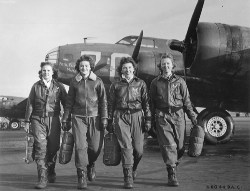
Figure 2.4 USWASP pilots after flight in B-17. [US National Archives, 342-FH-4A5344-160449ac.]
At its peak in 1945, the WAC had 100,000 members (at its inception the Army had hoped for 600,000). In all, during World War II, about 150,000 women served in the WAC, nearly 90,000 in the WAVES, about 25,000 in Marine reserves and Coast Guard SPARS, and 75,000 as officer-nurses. Total fatalities appear to be in the range of 200–300 women in all, but apparently few of these were by hostile fire.85
Although soldiers and officers who worked with US military women in World War II adjusted to them and came to value their contributions, public opinion lagged behind. The WAC’s biggest problem was in recruiting, especially after a “slander campaign” against it in 1943. The campaign promoted the idea that WACs were really prostitutes, or women with low morals. Leaders had to spend great energy trying to counteract this campaign both through public advertising and through attention to the women’s appearance (feminine uniforms) and their actual morals, which were generally upstanding. (In the British Army in World War I, officials omitted a breast pocket on women’s uniforms for fear of drawing attention to female anatomy.) Despite efforts to counteract the slander campaign, a survey of Army men in 1945 found that about half thought it was bad for a girl’s reputation to be a WAC. Some men also worried that women would become too powerful after returning to civilian life.86
In recruiting women for the WAC, the Army used trial-and-error methods to stir interest. A major recruiting theme, “Release a Man for Combat,” was abandoned – but could never be fully suppressed in the public mind – when women responded poorly to the notion that their participation could send an American man to his death. Later cheery themes, such as “I’m Having the Time of My Life,” were also unsuccessful. An all-out advertising and canvassing campaign in Cleveland in summer 1943 proved a total failure: personal contact with 73,000 families identified 8,000 eligible women, but brought only 168 recruits. At that rate the 100,000 new WACs needed immediately would require contacting 44 million families, more than the total US population. Waiving the requirement of high school graduation also produced few recruits. As a result of this failure to recruit an additional half-million WACs in 1943, the draft was extended to fathers of young families, even though a March 1944 US poll found that three-quarters of the public would rather draft young single women (for noncombat positions) than young fathers.87
Demobilization of women received top priority at the end of the war, as in other wars. When the war ended, one Navy commander declared, “I want all the women off this base by noon.” After World War II the number of women in the US military dropped drastically, but never back to zero. The World War II experience remained a valuable benchmark of women’s potentials as soldiers, which informed the later integration of women in the US military. In the Korean and Vietnam wars, women’s service as nurses was notable. Recently, a memorial to women veterans has been completed at Arlington National Cemetery, and the history of US women soldiers is becoming better known.88
Recent decades
The large-scale integration of women into the peacetime US military began in the early 1970s, coinciding with the end of conscription after the Vietnam War and the switch to an all-volunteer army. The number of women in the armed forces grew rapidly from under 3 percent to over 8 percent in 1972–80, then more slowly but steadily, reaching 14 percent by 1999. (These levels compare with a peak of 3 percent in World War II and below 1.5 percent from 1945 to 1968.) Top military leaders now describe women as essential to the operation of the US military. Given the ongoing integration of women into previously closed positions, such as flying combat jets or commanding warships (the first took her frigate to the Persian Gulf in 2000), the data here for the late 1990s will change over time.89
The current US expansion of women in the military comes in peacetime and has continued in a period of shrinkage of the US military (in the 1990s). Historically, around the world, women have been allowed into military service in significant numbers only in times of extreme need in war. The current US integration reflects the professionalization and technical bureaucracy of the US military, in which being a soldier is “a job” and cost-conscious organizational managers realize that women’s labor is cheaper than men’s labor of equivalent quality. (Women are now paid the same as men in specific jobs, but women in the all-volunteer force bring with them higher average levels of education.) The expansion also reflects the greater acceptance of liberal feminism in the country’s cultural and political norms – women and men should have similar rights in the workplace, and women can do “men’s” jobs.90
In theory the expanded use of women in the US military maintains women’s exclusion from combat. In practice, the lines between combat and support are not so clear-cut. A 1982 Army review noted:
Currently, women are assigned to duty positions and MOS [jobs] that require them to engage routinely in direct combat. Women may be found in every battlefield sector including forward of, alongside of, or interspersed with direct combat units….[T]he modern battlefield [is] an extremely fluid environment where many soldiers, assigned to units located in rear areas, are required to perform duties in forward combat areas.
For example, of the nearly 4,000 women then in the US Fifth Corps in Europe, 900 would be located in combat areas if the Corps participated in combat. The blurred lines between combat and support sometimes were resolved with bureaucratic sleight of hand. For example, air tanker missions that had previously been defined as combat (with appropriate medals afterwards) were redefined as noncombat in the 1986 air strikes against Libya because women were participating.91
In the 1989 Panama invasion – at that time the largest US military action since Vietnam – women soldiers gained a new visibility. Almost 800 participated, constituting about 4 percent of the total force. At least 150 were in combat areas, some coming under enemy fire and some returning fire. The female captain of a US military police unit, Linda Bray, became a celebrity after leading her unit in capturing a military dog kennel in a half-hour firefight. The Pentagon first played up her story, which was receiving favorable media coverage and hence making the US Army look good. However, when her story threatened to unleash political forces they did not want to face – pressures to lift the combat exclusion law for women – Pentagon officials reportedly leaked disinformation to undermine her account (which some media reports had in fact exaggerated). Bray faced persistent harassment after the episode, and left the Army in 1991.92
In the Gulf War, nearly 40,000 US women participated – 6 percent of the US forces deployed (i.e., about half the proportion of women as the overall military had). About a dozen women soldiers died, of whom five were killed by hostile forces. Despite Pentagon fears of a bad public reaction – there had been no women casualties in Panama – the deaths of women soldiers were taken in stride by the American public.93
The issue that most worried top military officials – the capturing of US female POWs – also fizzled. Two US women soldiers were taken prisoner by Iraqi forces and returned after the war – a truck driver who stumbled into Iraqi lines in an early battle and a flight surgeon shot down on a helicopter trying to rescue a downed US pilot. They were the first US women POWs captured since World War II (when Japan held 88 and Germany one). The military leadership’s fears, in addition to the potentially explosive public reaction which could undermine support for the war effort, were that male POWs might be induced to disclose information if women POWs with them were subjected to sexual abuse. These fears seem exaggerated, both because POWs have usually been (and were in Iraq) questioned and tortured in isolation to maximize psychological pressure, and because women pilots were already making sure men understood that rape was no different from any other torture and that if men caved in when women were abused they would put the women at greater risk of future abuse. Survival schools, which train pilots for their possible capture, had begun desensitizing men to rape, and preparing women for sexual abuse as they did men for torture. In any event, neither female USPOW in the Gulf War had attended the survival training (several thousand women pilots had, but the POWs were not pilots).94
In this case, Iraqi authorities made no attempt to exploit the US women’s gender. (The 1949 Geneva Conventions mandate treating women POWs “with all the regard due their sex.”) Once in custody of the government, the women were generally well treated whereas the men were tortured. Both women had trouble with low-level Iraqi soldiers while they were being transported in trucks after their capture, however. The doctor (whose arms were broken) was molested by one soldier and says she would have been raped if he had been able to get her flight suit off during the ride. The truck driver slapped away a soldier who touched her breast. Neither case destroyed the morale of the POWs, male or female. Opponents of women in combat later used the episodes, nonetheless, to underscore the dangers to women soldiers.
Even more than earlier wars, the Gulf War made it hard for the US military to maintain the distinction between combat and noncombat. In the Gulf War, more than half the 375 US soldiers killed were support personnel, not “combat” troops. The Pentagon followed the rule (as in Panama) that if a soldier was female she must not have been in combat and could not receive combat medals (which are highly valued in military culture). For example, the female doctor POW (Rhonda Cornum; see p. 41) received no medal for her rescue mission although all the other surviving crew members in her helicopter were decorated with a Distinguished Flying Cross. Similarly, the Pentagon would not designate the US truck driver a POW when she was captured, and listed her simply as “missing.” They persisted even though her truck had been last seen stuck off the road with Iraqi soldiers running up to it, and later was found without the two drivers, and even though US pilots over Baghdad later spotted her in a prison compound. When she was released after the war and appeared on TV wearing a yellow uniform stamped “PW,” her father called a Pentagon official at 3 a.m. and said, “Now, you asshole, will you declare her a prisoner of war?”95
Overall, the Gulf War was a big victory for liberal feminism. Women participated in large numbers, and performed capably, and the public proved willing to accept women soldiers as casualties and POWs. The Pentagon’s fears proved inflated, and its efforts to manage public perceptions (such as by silencing information about sexual assaults in the ranks) proved easier than expected. The main problems that arose from the women casualties and POWs were that they generated huge media interest which sometimes caused resentment among male colleagues and sometimes also was unwelcome to the women and their families. These problems arose mostly because of the novelty of the situation.96
Current issues In the 1990s, some problems in US military gender integration persisted, in basic training, military academies, and “sex scandals.” Both military academies and basic training socialize new soldiers (officers and enlisted, respectively). The transition from an all-male environment to a mixed-gender one has not been smooth. Sexist elements in military culture have been slow to change, and harassment of women is widespread. Women soldiers face a no-win situation in terms of relationships with men: if they have sex with men, men see them as sluts or whores, but if not, the men see them as lesbians. In a 1992 Pentagon survey, about one-third of women soldiers reported experiencing some form of verbal or physical sexual harassment or abuse. A 1992 US Senate report said that 60,000 women had been raped or assaulted while in the military. (Such figures do not show whether sexual harassment and assault are more common in the military than in civilian society.)97
Pregnancy in the ranks, a controversial political issue, is not a major military problem. A retired admiral compares the pregnancy rate of about 10 percent with the “much higher disciplinary problem with the men, unauthorized absenteeism, absence in the brig for more serious offenses. Pregnancy is a wash.”98
In US military academies – West Point for the Army, Annapolis for the Navy, and the US Air Force Academy in Colorado, alongside various other private and public military academies – women have been integrated since 1976. The academies graduate about 600 women a year, who enter with records as distinguished as their male peers, perform equally in the academies, and go on to successful military careers. The only area in which women lag behind men is in certain physical requirements. Although many women keep up with the men on rigorous marches at West Point, other women (in disproportionate numbers) fall behind or need men’s help lightening the load. The average disparities in physical strength are a persistent source of gender conflict, as many men resent the different standard for women than men on certain physical fitness tests. (In the case of greatest difference, men must do ten pull-ups but women only three.)99
In surveys of graduating West Point seniors in the 1980s, fewer than a third of women cadets felt “totally accepted” by other cadets, compared to over half of men. As one male cadet put it, “I would never openly harass women, [but] I hope they understand they are not welcome here.” Women cadets dropped out of West Point at twice the men’s rate after the second summer which emphasizes combat training (which women would not be allowed to put to use). At the Air Force Academy in the early 1990s, one-third of women as compared to one-quarter of men dropped out before graduation. In the 1990s, incidents of sexual harassment apparently increased at the academies. Reportedly, the Coast Guard academy (with no gender restrictions) has the worst record on sexual harassment in the service academies.100
The rough transition is perhaps to be expected; cultures change slowly. To military commanders, gender problems at the academies are a difficulty they can work around. As one West Point officer put it, “This is not an experiment. This is an operational reality.” Men’s and women’s feelings notwithstanding, the military is getting the officers it needs – which must include women in order to meet the needed quality and quantity. Furthermore, despite the sexist culture, most women are getting through the academies with records equal to those of the men. In the words of one woman officer formerly at West Point, “In a nonnurturing environment, they are kicking ass. And that is the bottom line”101
In basic training, the problem of unfair treatment (lax or harsh) revolves around the relationship of drill sergeants and company commanders with their troops. By tradition, harsh treatment in boot camp helps socialize new troops into discipline and hierarchy. The drill sergeant – typically male – has unparalleled power over his troops. If some troops are female, this power can be used for sexual domination. In the mid-1990s several abuse-of-authority cases came to light, most visibly at the Army’s Aberdeen Proving Grounds where NCOs were accused of a widespread pattern of rape and sexual abuse. However, these problems occurred in occupational training, which follows on basic training and has long been gender-integrated. Congress in 1998 debated mandating the separation of genders during basic training, a move suggested by a commission but opposed by the Pentagon as impractical (since men and women go on to serve together). Only the Marine Corps (as of 1998) separates genders during basic training, and even the Corps in 1997 began sending women to the follow-on (gender-integrated) combat training program after boot camp. As one male trainee said, “Men or women, that doesn’t matter…. All we see is another Marine.” The Navy’s boot camp, with about 15 percent women, uses mostly all-male divisions with the rest having equal numbers of men and women (to avoid problems that arise when a few women are scattered in a heavily male group).102
Also complicating US military gender integration in the 1990s, sex scandals of various types brought unfavorable publicity and fueled political debates. The first woman to pilot a B-52 bomber with nuclear weapons (a symbolically important role) was forced to resign after she was accused of having an adulterous affair and then lying about it. Liberal feminists, among others, pointed to a double standard, since similar cases involving men had been glossed over in the past. In the wake of the public controversy, a male nominee for Chair of the Joint Chiefs of Staff was passed over because of an affair decades earlier. Military sex scandals moved out of the news, at least temporarily, when journalists’ focus switched to the White House in 1997.103
New combat positions While these general issues of gender integration swirled around the US military, the actual focus of women in combat shifted to combat aircraft and ships – the positions most often open to women in the NATO countries discussed earlier. In considering military jobs related to combat in which women might be included, the US military reproduces roughly the same spectrum of tasks discussed earlier under NATO countries. For example, a 1993 survey of retired high-ranking officers regarding women in combat showed, in addition to greater support among those more recently retired, greater support for women in warplanes (29% yes), attack helicopters (24%) and combat ships (24%) than in artillery (22%) and combat engineering (17%), with least support for women in armor (12%) and infantry (10%).104
In 1990, an Air Force officer testified to Congress that women – then barred from only 3 percent of jobs in the Air Force, namely aircraft actually engaged in combat missions – “can fly fighters, they can pull Gs. They are physically capable and, I think, emotionally capable.” After the Gulf War, a Presidential Commission on women in combat recommended by a split vote to keep the status quo, but the Administration lifted the combat exclusion for women on almost all airplanes and ships (except submarines and Navy commandoes). Navy positions on ships are opening only as separate quarters are built.105
Naval aviation also has opened up and several women have flown combat missions (in Iraq since 1998 and in Serbia in 1999). Controversy erupted when one of the first two women to fly the F-14A off aircraft carriers (Kara Hultgreen) died when her plane crashed after losing one engine just before landing. Opponents of women in combat aviation – including many of the Navy’s male pilots – seized on the accident and claimed that the pilot had substandard flight skills which were tolerated only because of her gender. It appears that Hultgreen’s inexperience, rather than substandard skills, caused an equipment failure to spiral to disaster when an experienced pilot might have prevented the crash. Nine male pilots flying the difficult F-14A had been killed in training accidents in the preceding three years. Eight out of nine male F-14A pilots who reenacted Hultgreen’s landing sequence in a flight simulator also crashed.106
The Army and Marine Corps have been more resistant to women in combat. Nonetheless, in 1994 the Army opened combat support positions to women, allowing them into 20,000 previously prohibited jobs at brigade headquarters (closer to the front line). Three years later, however, fewer than 1,400 women had been assigned to those jobs, most doing traditionally women’s work (administration, health care, supply) in the newly opened units.
Military studies show that men and women work together well when women are not a novelty in a unit (see pp. 199–203). With the opening of new positions closer to combat, women became a novelty in those units (just as they still seem to be for each entering class at the academies, and in basic training). The Army makes no attempt to avoid assigning one or two women alone to a unit of several hundred soldiers, nor does it train male soldiers effectively to work with women better. As a unit works together, however, and especially if it deploys in the field, unit bonding appears to overcome gender divisions to a great extent.
Women soldiers who made up 10 percent of US forces in Bosnia in 1997 reportedly had “easygoing and untroubled” relations with the men. For one thing, with US peacekeeping troops there wearing protective gear almost all the time, gender was less visible – it took one infantry colonel a week to realize that some of the MPs protecting him in the field were female. In peacekeeping operations, women MPs are generally closer to the “front lines” than are the all-male infantry and armored units. Lines are further blurred by the Army practice of ignoring regulations and using females in supposedly off-limits jobs when practical considerations make it the best way to get the job done. Among the US forces in Bosnia, women blended in by adopting stereotypically “macho” attitudes and behaviors, including swearing, smoking cigars, and getting a thrill from firing guns. Most importantly, they adopted a “warrior spirit.” As one female US Lt. Colonel who commanded a Military Police battalion in Bosnia put it, “If a woman thinks like a warrior, believes she’s a warrior, then she’ll do what it takes. Most women don’t think they have it in them, but once you let that spirit loose you find that aggressiveness.”107
The political debate Every step of the way, the experience of integrating women has fueled a raging political debate. The two sides tend to draw on two kinds of moral arguments. One concerns fairness – whether it is proper, desirable, or just to allow women to participate in combat if they so choose, or even to assign women soldiers to combat on the same basis as men. The second category deals with the effectiveness of the military and whether the participation of women in combat would reduce or increase (or neither) its readiness, fighting ability, and morale.108
Those who favor allowing women in combat rely on the fairness argument, and think the effects on military performance would be minimal. Women should be allowed any job opportunities for which they are individually qualified, not barred because of their gender alone. This view extends the logic applied to other occupations from which females were traditionally excluded, from police and firefighters to corporate managers, political leaders, and so on. Especially in today’s large and bureaucratic US military, being a soldier can be a career path. Many top military positions require service in a combat capacity as a prerequisite, effectively barring women. Congresswoman Pat Schroeder said of the combat exclusion laws that “the only thing they protect women from is promotion.” A focal point of women’s efforts to increase gender fairness in the military is the Defense Advisory Committee on Women in the Services (DACOWITS). It was created by Defense Secretary George C. Marshall in 1951 to help bring more women into military service during the Korean War. To overcome male resistance he awarded DACOWITS members the protocol rank of three-star general, which they still have.109
Those who oppose women in combat rely on the effectiveness argument – that the military needs to put priority on its main mission of winning wars, not on social-change experiments. For example, retired General Norman Schwarzkopf said: “Decisions on what roles women should play in war must be based on military standards, not women’s rights.” However, some opponents of women in combat also rely on a “fairness” argument. They see protection for women as men’s end of a gendered division of labor: “Good men respect and defend women.” A widely reported exchange between Senator William Cohen and Air Force General Merrill McPeak took place soon after the Gulf War:110 |
| Cohen: | “Suppose you had a woman pilot….of superior intelligence, great physical conditioning, in every way she was superior to a male counterpart vying for a combat position. Would….[you personally] because you would not want to see the risk to her life increased….pick the male over the female under those circumstances?” |
| McPeak: | “That is correct.” |
| Cohen: | “So in other words you would have a militarily less effective situation because of a personal view.” |
| McPeak: | “Well, I admit it doesn’t make much sense, but that’s the way I feel about it.” |
|
The two sides interpret the same set of episodes from the late 1980s and early 1990s differently. As in the movie Rashomon, contradictory versions of the same episode seem credible and coherent, with the “truth” being difficult to pin down. Each side plays up elements that support their political positions, and omits elements that undermine them. Each side accuses the other of manufacturing false information – to slander military women (with the collusion of male military officials), or to cover up military women’s failings (with the collusion of liberal media and politicians), depending which side you take.
Pro-feminist Linda Francke and anti-feminist William Breuer, for example, tell contradictory stories about Linda Bray’s experiences at the Panamanian military kennel (see p. 94). According to Francke, Captain Bray arrived at the kennel – which turned out to be a base and weapons cache for Special Operations troops – ten minutes into a fierce half-hour gun battle in which the unit she led was outnumbered by Panamanian defenders firing from the surrounding woods. She took cover in a ditch, fired her pistol at the enemy once, and rode in the armored vehicle that crashed through the front gate. A few days later, three Panamanian soldiers’ bodies were found in the woods, probable casualties of the Bray-led attack. According to Breuer, however, the kennel was militarily insignificant, there was only some sporadic fire and Bray was not even there at the time. She did not crash through the gates or lead her men in combat. Breuer focuses on exaggerated media reports of a long firefight with many dead Panamanians strewn about (one report refers to “a three-hour-long infantry-type battle”). Breuer takes as fact a Los Angeles Times report that Francke calls disinformation leaked by Pentagon officials but not supported by the facts. Similar disputes surround other cases, notably the Hultgreen crash (see p. 99).111
Women’s work
Despite the creeping proximity of women to combat, the gender structure of labor in the US military continues to place women primarily in traditionally feminine areas. The large-scale gender integration creates more of the rare cases of women in and near combat, but these “newsworthy” cases should not blind us to the general pattern of gendered labor.
In the first plans for a women’s corps drawn up in the 1930s, the US Army conceived of women as “a menial type of corps of low-grade personnel.” Nearly half would be used as clerks and stenographers, with the rest divided between domestic services (cooking, sewing, laundry, and cleaning), driving, labor, and other unskilled occupations. A few would be skilled workers such as telephone operators.112
In World War II, the Army realized it could save money by substituting women for men soldiers. Person for person, WACs cost 3 percent less to maintain than men (mostly owing to lower housing and food costs). More importantly, although women replaced men at a one-to-one ratio in driving and mechanical jobs, one woman could do the work of two men in traditional women’s jobs such as clerical work. From this experience came the idea decades later – in the all-volunteer force where labor was a commodity to be bought, not conscripted – that budgets could be best utilized by drawing on either men or women according to individual ability for a particular job.113
Today, US military women are strongly concentrated at low ranks and pay grades (Figure 2.5). Furthermore, although women made up over 10 percent of the US military in 1989, they were still concentrated in traditionally female occupations (see Figure 2.6). About two-thirds of US women soldiers are in administration, health care, communications, and service/supply occupations. They are the successors to the historical secretaries, nurses, telephone operators, and “camp followers” (who once did the cooking, sewing, laundry, cleaning, and supply roles). The main area of change, in terms of women in nontraditional roles, is in equipment repair. Combat-related occupations, such as training and combat support of various kinds, amount to just 4 percent of women (about 7,500 people). Women make up about one-quarter of health care and administration personnel, about 10 percent of service, communications, and technical personnel, and just 2.5 percent of combat-related personnel. These data understate women’s combat exposure in the Navy, where 15 percent of women serve on ships and women in traditional occupations may serve in combat positions (e.g., nurses on combat ships). The opposite applies for the Army, where women in nontraditional occupations are banned completely from combat positions, including infantry, armor, and most artillery units. Although women helicopter pilots received public attention during the Gulf War, in 1991 women pilots represented under 5 percent for each branch – Army, Navy, and Air Force – fewer than 1,000 pilots in all (not counting women navigators and aircrew).114
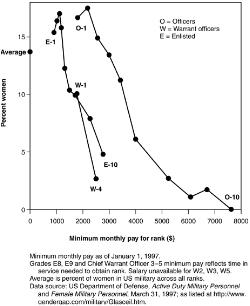
Figure 2.5 Percent women at each pay rank, US military, 1997.
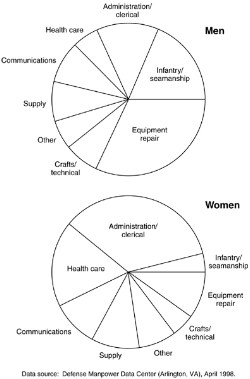
Figure 2.6 Occupations in US military (enlisted) by gender, 1998.
In the US Army in 1997 – after the opening of some combat-support occupations and positions to women but while most women were in occupations chosen before that opening – women troops were still concentrated in administration (one-third), health care (one-sixth), and service and supply (one-sixth). For men, fully 32 percent were in infantry, gun crews, and seamanship. Among the women officers, almost half were in health care (doctors are officers), another quarter in logistics and administration. For male officers, by contrast, almost half were in tactical operations. These differences are gradually eroding from year to year, however.115
One could argue that women are in the traditional roles because these are the roles they want and are best at. Indeed, most women soldiers do not want combat assignments – but then neither do most men. In a 1992 US survey, 12 percent of enlisted women and 14 percent of officers said they would volunteer for the combat arms if allowed to do so. Another 18 and 15 percent, respectively, said they might do so. (About 75 percent of women soldiers thought that women should be allowed to volunteer for combat.) These numbers translate into a pool of nearly 25,000 current soldiers, and possibly twice that number, ready to volunteer for combat.116
Overall, the results of the US experience indicate a broad, deep, and well-rounded capability of women to participate in the kinds of actions and operations required for combat, and to hold their own in combat itself when drawn into it. Most of the problems revolve around men’s difficulties in adjusting to the presence of women in their midst, and even those problems are most acute when women are a novelty and much less so after men work together with women soldiers. The US experience is significant because it is occurring on a very large scale – the largest such effort ever in peacetime. |
| |
| C. INDIVIDUAL WOMEN FIGHTERS |
The most widespread involvement of women in combat has been neither in all-female nor in gender-integrated units, but rather as individuals scattered through the ranks. Such women combatants are found in many cultures around the world, and in many historical periods, although generally in extremely small numbers compared to male combatants. Put together, these thousands of cases add up to a strong endorsement of the conclusion that individual women can hold their own in combat when circumstances permit (or force) them to do so.
Cross-dressers
Historically, women who have participated in combat usually did so disguised as men. An Englishman joked in 1762 that “so many disguised women were serving in the army that they ought to have their own regiments.” This presents a real problem for assessing the evidence: we cannot know how many women have successfully participated in this manner – surviving (or being buried) without detection. We can only know those whose gender came to light, which most often occurred after a serious injury requiring prolonged medical care. Historically, most armies have not provided such care in the way we take for granted today, and wounded women may have left the ranks without discovery. Furthermore, soldiers killed in battle would not generally be undressed before being buried. Thus, we do not know how many women lie in soldiers’ graves. Nonetheless, scholars have documented enough cases of cross-dressing women warriors, discovered before or after death, to draw some inferences.117
Women soldiers in men’s clothes are found in most regions of the world. In the old Chinese story of Mulan, a young woman dresses as a man, serves in the army in place of her sickly father, earns distinction, has her gender discovered after the fact, and ultimately returns home to a feminine role. Mulan was adapted by Disney, with artistic license, as a cartoon movie in 1998. Although probably a fictitious or composite figure even before Disney got hold of her – scholars disagree about when and where she lived, and even her family name – she is probably based on real cases. This basic story recurs in various cultures, including several true stories (perhaps exaggerated for commercial reasons) that spurred popular books, articles, and speaking tours. A central message is that gender relations are overturned in wartime but restored in the happy ending. For example, Franziska Scanagatta reportedly graduated from the Austrian military academy in 1797, during the French Revolutionary Wars. She served in the campaigns of 1797 and 1799, and was promoted to lieutenant in 1800. However, her gender was discovered the next year and she left the army, marrying another lieutenant and having four children. In the US Revolutionary War, Deborah Samson (sometimes spelled Sampson) apparently did serve in male disguise, although her later autobiography and lecture tour were fictionalized. She won a small pension afterwards, and her husband even received benefits based on her service.118
The Civil War
Among the best documented cases is the US Civil War. It took place in a transitional era when the military was organized enough to maintain records on individual soldiers but not organized enough to provide all entering soldiers with detailed physical exams. Women participated on both sides. Most women serving at the front in the Civil War did so as nurses (Clara Barton being the most famous), and others served as “daughter of the regiment” – a morale booster and support person (similar to the Israeli role mentioned earlier). These nurses and “daughters” stayed just behind the lines, in theory, but in fact were sometimes caught up in battle. Other women accompanied the troops until combat became imminent, as wives and girlfriends, cooks and laundresses.119
In several dozen documented cases, women dressed as men and fought in the ranks. For example, “Frank Mayne” (Frances Day) disguised herself to follow her lover into the Union Army, stayed on after he died from disease a few weeks later, and was promoted to sergeant. Her secret was discovered when she was mortally wounded in battle. Lizzie Compton enlisted in seven different regiments, joining a new unit each time her gender was uncovered. “Frank Martin” (Frances Hook) fought in Tennessee in 1862 but was mustered out, against her pleas, when her gender was discovered after she was seriously wounded in battle. She reenlisted in a Michigan regiment in Kentucky, was found out again, and reportedly served later in an Illinois regiment. Hook was, according to the Michigan regiment records, “quite small, a beautiful figure….large blue eyes beaming….exceedingly pretty and very amiable.” By contrast, another woman soldier wounded in the same Tennessee battle (in a Minnesota regiment), Frances Clayton, was described as very tall and masculine looking. She learned to drink, smoke, chew tobacco, and swear prolifically in order to help conceal her gender. Clayton had enlisted to be with her husband. Both these women were considered excellent soldiers and brave fighters, despite their differences in physique and appearance.120
“Albert Cashier” (Jennie Hodgers) served for three years with the Union and was in combat forty times, notably in the brutal 1863 battle for Vicksburg, Mississippi, where Cashier’s name is inscribed on the battlefield monument. Cashier was considered dependable, healthy, and fearless by her commanders – the equal of anyone in “his” company, despite a lack of size and brawn. She continued to pose as a man after the war, her story coming to light only in 1913 at age 70, shortly after Hodgers was sent to a hospital for the insane. The story caused a minor sensation. Hodgers’s former sergeant visited and reported her “broken” because “she was compelled to put on skirts.” She told him: “The country needed men, and I wanted excitement.”121
On the Confederate side, generally fewer women served near the front than on the Union side, although some women served in support roles usually called “mother” of the troops. Some Confederate women did serve while disguised as men. “Richard Anderson” (Amy Clarke) enlisted in the Confederate army with her husband, stayed after he was killed, and was captured by the Union and released in a dress after her gender was discovered. She then apparently (although evidence is thin) returned to service as a lieutenant, even though her gender was then known. Lucy Matilda Thompson – tall, masculine, and an expert shot – also enlisted in the Confederate army with her husband, and was discovered only after serious injury.122
While some women believed in the Confederate cause, others joined only to remain close to husbands or boyfriends. Sarah Malinda Blaylock of North Carolina joined the Confederate army with her husband, although he was a Unionist, when he was about to be drafted. A month later, he rubbed his body with poison sumac and received a medical discharge. She immediately revealed her identity and was discharged as well. They went on to become Unionist partisans, and led raiding parties from the Tennessee mountains.123
The most famous women soldiers of the war served as spies and published their stories afterwards. “Franklin Thompson” (Sarah Emma Edmonds) adopted a male identity before the war and worked in the Union army as a “male” nurse and mail carrier who was recruited to the secret service and slipped behind Confederate lines on numerous occasions to bring back vital military information (Figure 2.7). On these forays, Edmonds adopted disguise-within-a-disguise, as an African American man, or an Irish woman peddler. She lived through many battles, deserted the army when her identity appeared to be in jeopardy, and published a best-selling book in 1864, Nurse and Spy, about her escapades, told as though she were a female nurse who sometimes adopted male disguise. She was the only woman ever accepted into the veterans’ group, Grand Army of the Republic, in 1898. (Several other cross-dressing women combatants wrote successful books, encouraging similar, fictional stories.)124

Figure 2.7 Sarah Emma Edmonds as “Franklin Thompson,” US Civil War. [Courtesy of State Archives of Michigan.]
Edmonds’s counterpart in the Confederacy was “Lieutenant Harry T. Buford” (Loreta Janeta Velazquez). With the help of a fake moustache and beard, Velazquez fought with the Confederate army as an independent lieutenant (floating from one unit to another as needed) in 1861, and at least twice temporarily took charge of a company that had lost its officers. She served under her fiancé without being recognized by him, worked as a spy switching in and out of male and female attire, and was arrested by both the North and the South numerous times on charges of spying or (in the South) being a woman, only to get away each time and carry on. After revealing herself to her fiancé (when both were recovering in a hospital) and marrying him, only to have him die weeks later, Velazquez gave up male disguise and turned to spying full-time, as a woman. She became one of the South’s most effective secret agents, working as double (and once triple) agent under the North’s secret service, counterfeiting large sums in the US Treasury to finance the Confederacy, blockade-running through Cuba, and making a clean getaway at the end of the war. She published her controversial memoirs in 1876.125
Many women were discovered quickly and discharged – often victims of their “feminine” mannerisms, such as how they put on stockings or wrung out dishcloths. Two soldiers were found out when officers threw apples to them, which they tried to catch with their aprons (they were not wearing aprons). Another, according to an 1862 newspaper account, was found out after “trying to put her pants on over her head.” Several women were discovered after giving birth, including a Union sergeant whose delivery was “in violation of all military law” according to an outraged superior officer, and a Confederate officer who gave birth after being taken prisoner by the North. Many women, however, were discovered only after injury or death, and an unknown number either were buried on the battlefield or survived the war undiscovered. Of course, while hundreds of women soldiers may have fought in the Civil War, hundreds of thousands of men did. The participation of women was limited in that they almost always had to pretend to be men in order to fight, and they were summarily dismissed or punished when discovered.126
Women at sea
Women have participated in naval warfare and as pirates on a number of occasions, in a variety of roles – disguised as men, working in support jobs on ships, and in rare cases as openly female combatants. In the sailing ships of the British Navy in the eighteenth and nineteenth centuries, it was common for women to accompany men to sea, both as wives and as service workers (prostitutes, cooks). As Figure 2.8 illustrates, in time of battle women participated under fire, facing many of the same dangers as the men. They traditionally helped nurse the wounded and carry gunpowder to the cannons. The latter was an especially difficult and dangerous task, since heavy cartridges had to be carried from the (spark-free) powder room up ladders to the slippery and smoke-filled gun deck, over and over. It was “not unusual” for the noise, vibration, and stress of battle to induce labor in a pregnant woman, who gave birth with little assistance from others.127

Figure 2.8 British seaman’s wife helps a wounded seaman in battle, 1830. [From Matthew Henry Barker, The Log Book. London: J. & W. Robins, 1830.]
These combat support roles for women at sea are supplemented by quite a few cases of women who adopted male dress and joined the Navy as regular sailors – usually motivated by economic and social restrictions faced by women on land (and by pure adventurousness). Of three biographies of eighteenth-century women who went to sea with the Royal Navy, one turns out to be accurate, one is embellished with fiction, and the third entirely fictitious. The public showed both tolerance of, and amusement at, the story of a woman dressing as a man and taking to sea, especially if she went in search of a lost love (which few real women did) and returned to normal gender roles at the end of the story. It was surprisingly easy to pass as a man in the eighteenth century, when men were routinely press-ganged into naval service to fill labor shortages in the war-prone British Navy. As with all cross-dressing female soldiers, it is hard to estimate numbers of real historical cases behind the popular ballads.128
Openly female fighters
The form of female participation found least often is the isolated individual female soldier who, without gender disguise, fights among her male comrades. Cultures tend to treat these as exceptional cases, decoupled from any idea of women’s systematic participation. For example, the Russian Naval Academy’s first female cadet, admitted in 1997, is being treated as an exception – admitted by special decision of the Defense Minister. To quote an officer at the academy, “One girl alone cannot ruin the navy.” Many stories describe individual, remarkable women who simply went to war as women, their strong abilities usually convincing males to accept them despite their gender. Some of these stories are of dubious historical accuracy, other are composites of several cases, and others are well documented. The phenomenon of individual, openly female warriors is widespread and yet, in most times and places, rare.129
Simple societies In several simple, prestate societies, women sometimes participate in fighting. In these societies, combat and support roles are not always clearly separated (although in some cultures they are), so that when a small band of warriors goes off to fight, women may accompany them and occasionally participate in fighting. I have mentioned the case of women of the Eurasian steppes in the early Iron Age (see pp. 13–14). Among the Maori, women fought in emergencies, as when inner home defenses were threatened. This was unusual, however. As the Maori proverb says, “Fighting with men and childbirth with women.” Several other cases illustrate women’s participation, although in none of them do women play a role equal to men in combat.
Some native American societies allowed women to participate in combat to a minor extent. Among the southern Apaches, some women accompanied war parties and a few “also fought and were known for their bravery and expert marksmanship.” Reports are somewhat contradictory, however. Cremony reported in 1868:
Many of the women delight to participate in predatory excursions, urging on the men, and actually taking part in conflicts. They ride like centaurs and handle their rifles with deadly skill….[T]he fighting women….are numerous, well trained, and desperate, often exhibiting more real courage than the men.
However, a 1941 report states that Apache raiding parties were “made up of men only. Women never go on raids.” Nonetheless, prisoners taken in battle were often taken back to camp for the women (especially those who had lost loved ones in battle) to torture and kill. Apache girls and young women received much physical training including riding and using knife, bow, and rifle – and were expected to guard camp while males were away. Adult women occasionally joined a raiding or war party, usually to help with cooking, cleaning, and nursing.130
The most famous woman Apache warrior was Lozen, who rode and fought with Geronimo (against the US and Mexican armies in the late nineteenth century). Lozen was unusual because she was not married. A witness who, as a child, rode with Geronimo’s band recalls: “Lozen….was called The Woman Warrior; and though she may not have had as much strength as one of the men she was as good a shot as any of them.” This witness mentions that “no unmarried woman was permitted to go” with a war party. “Lozen? No, she was not married…. But to us she was as a Holy Woman…. And she was brave!” Lozen, the sister of Chief Victorio, reputedly used her powers as medicine woman to detect the enemy’s presence and help the Apache warriors elude capture on many occasions. After her brother’s death, Lozen rode with Chief Nana, who – with a force of 15 to 40 warriors – eluded a US force of over 1,000 soldiers and won eight battles against them. Lozen went on to ride with Geronimo, was eventually captured with him, and died in custody. Clearly, however, Lozen was the exception. Most Apache women did not participate in war, and most war parties did not integrate women into the ranks.131
On the long war expeditions of the extremely aggressive Mundurucú (Brazil), warriors were joined by their wives and “a number of unmarried girls. Their tasks were to carry cooking utensils and all of the equipment of the men, except for their arms…. They also cooked, fetched water and firewood and performed other female services. Contrary to [an 1831 report]….that the women helped on the battlefield….the women were always left at a safe distance” during fighting.132
Cheyenne Indian women also occasionally, though rarely, went with war parties, and showed courage equal to the men. When the chief’s horse was killed in a battle in 1876, his sister charged in among the white troops and rode away with him to safety. According to some reports, Cheyenne women who had been in wars formed a small guild and held meetings. Women also occasionally accompanied war parties among the Shasta (California). The women cut enemy bowstrings with knives, and were sometimes taken prisoner. They also cooked and carried supplies. The Gabrielino society (California) – wrongly characterized by nineteenth-century writers as “timid and peaceful” – used women and children to accompany war parties, carrying the food and supplies, as did the Hidatsa, Choctaw, and Guiana Amerindians. Possibly, Klamath (Oregon) women fought other women in war. The Konkow sometimes allowed women to participate in torturing captured male enemies.133
Women’s participation in torturing and killing prisoners is found elsewhere as well, scattered across the anthropological record of cross-cultural research on simple societies. For example, among the Tupinamba of Brazil, women enthusiastically helped torture prisoners of war to death and then dismember and eat them. Similarly, Kiwai women of Oceania had the special job of “mangling” enemy wounded and then killing them with knives or digging sticks. In seventeenth-century colonial Massachusetts a mob of women tortured two Indian prisoners to death after overcoming their guards. Afghan women in the nineteenth century tortured enemy survivors of battle. In 1993 a mob of Somali women tore apart four foreign journalists.134
It is possible, incidentally, for a culture to mobilize women into combat support without taking away their noncombatant protected status. In Papuan warfare, women “collect stray arrows for their husbands” and scout enemy movements, enjoying immunity from attack. Kapauku warfare (New Guinea) extends total immunity to women who function as support troops in the middle of the battle. “The Kapauku consider it highly immoral for a man to shoot at a female during a battle. Even an accidental injury brings….derision and loss of prestige.” These cases highlight the distinction between combat and combat-support categories.135
In Celtic traditions, women warriors are a recurrent theme. Beyond the historical cases, warrior queens of dubious historical basis also figure prominently in legends and myths of many cultures. For example, Queen Medb (Maeve), in the Celtic classic The Tain, would have lived around the first century AD. In the legend, the goddess-warrior Medb commanded 1,500 soldiers but was most fearsome as a single warrior. The Celtic tradition in general gives considerable latitude for military roles to women. In Celtic myth, “again and again it is the magic intervention in the course of battle of a female, goddess, queen or a combination of the two, which provides the focus or climax of the story.” Legends refer frequently to warlike queens and goddesses, but little hard evidence indicates actual women fighters. Even the goddesses of war generally do not engage in battle, but use magic to influence battle outcomes, or sometimes train men in the art of war. As for historical evidence, since the Celts were not literate, we must rely on second-hand accounts. A Roman historian claimed that if a Celt called in his wife, foreigners would be hard pressed, since she was stronger than him and could rain blows and kicks of amazing strength on the foreigners. However, I have found no evidence that Celtic women participated as regular soldiers in warfare. If they did so, they left little trace.136
Historical cases in industrialized societies In industrialized societies, individual women have also fought openly on occasion. In the French Revolutionary Wars, which first mobilized a whole national population for war service on a mass scale, several hundred women proposed forming a women’s militia. A proposal for a women’s battalion was considered, but rejected, in 1793. However, Renée Bordereau served openly in the royalist cavalry, fighting with “unbelievable courage,” evidently out of rage at the murder of 42 of her relatives (including her father before her eyes). Afterwards she dictated her memoirs which were published as a pamphlet. In the French siege of Saragossa, Spain, in 1808, a Spanish woman named Agostina served with hundreds of women bringing drink to the 200 defending soldiers and water to swab the cannons. When the French broke through and killed all the artillerymen, Agostina began firing a cannon, and other women joined in, forcing a French retreat. After the war, she continued as an artillery captain, in uniform with standard pay and pension, despite being openly female. A French woman, wearing male clothing but known by all to be female, fought competently in Corsica in 1792–99, and retired as a sergeant major after being wounded. Another woman served openly in the French army in 1793–1815, was wounded six times, and dictated her memoirs afterwards. No attempt was made to discharge her, because she fought well.137
In at least two cases in the US Civil War, similarly, women served openly as officers in the Confederate army at the rank of captain (in addition to those disguised as men). During World War I, a number of women participated individually in several armies. One of the most famous, Englishwoman Flora Sandes, fought with the Serbian army on the same terms as the men, and took an Austrian speaking tour in 1920.138 |
| |
| D. WOMEN MILITARY LEADERS |
Just as individual women have proven capable as soldiers, so too they have shown themselves adept as military leaders. Male soldiers and officers will follow the commands and exhortations of a female leader – and not just one whose gender is disguised – when that leader is deemed to possess proper authority.
Joan of Arc The most famous case – although it is atypical – is Joan of Arc. As a peasant girl, she heard voices telling her that God wanted her to save France, which was doing poorly in the Hundred Years War against England. The English, with the collusion of some French forces, occupied much of France including Paris and the cathedral of Reims where French kings were crowned, and were besieging Orléans. At age 16, Joan somehow convinced the French ruler to provide her some troops and send her to Orléans, where (in 1429) she rallied the demoralized army trying to relieve the siege. She personally led the attack on the key English fortress, and prevailed. Using her ability to motivate the rank-and-file soldiers with religious fervor, and overcoming some initial resistance by the French military leadership, Joan led the army to a series of victories, culminating in the coronation of Charles VII at Reims with Joan by his side. These successes turned the tide of the Hundred Years War. The next year, Joan was captured by Burgundy and sold to the English, who condemned her both for idolatry and for wearing men’s clothing, and burned her at the stake.139
Joan’s main strength as a military leader was her ability to inspire troops to follow her. Leadership is critical in overcoming the paralyzing terror and confusion of soldiers on the battlefield (see pp. 253–58). Joan pro- vided the necessary strong leadership, in a manner not unlike that of the captains of mercenary units at that time. The mercenaries would risk their lives for their captain and were rewarded with plunder, whereas Joan’s troops were rewarded with spiritual ecstasy. The French soldiers believed that Joan was a holy presence. They loved her, and rushed to touch her, or her horse. Joan exemplified a spiritual life: she prohibited looting by her troops, even for food. She was charitable to all. She chased away pro-stitutes (who follow armies; see pp. 342–48). She prayed frequently and heard mass daily. In battle, she refused to shed blood personally, preferring to carry her standard instead of using her sword. Reportedly she could not stand the sight of blood. Her soldiers – the same ones those prostitutes had been serving – claimed they were not sexually aroused around her, even when they saw her breasts or bare legs (when she was dressing, or wounded). Instead, the soldiers “relished the spirituality of their own existence when with her.” In addition to these qualities, Joan appears to have had a knack for military tactics. She was especially adept at riding a horse while wielding a lance, at setting up artillery (which was fairly new), and at organizing armies for battle. Her contemporaries described her as a simple, innocent, and ignorant girl except in the art of war, where she acted as though she had 30 years’ experience.140
Warrior queens
Most women military leaders, unlike Joan, were queens who held political power and exercised military leadership from that position. Antonia Fraser reviews the record of a dozen such historical “warrior queens.” Different stories treat such figures differently – for example, some emphasizing their chastity and others their sexual voracity.141
The documented historical cases include Semiramis (Sammu-ramat), who ruled Assyria in 811–806 BC after her husband’s death and before her son came of age. Not much is known about her, but Greek writers built her up into a legendary adventuress, conqueror, and voracious lover – a story further embellished, centuries later, in a Voltaire play and a Rossini opera.142
The forces of Tomyris, queen and general of the Massagetae in today’s eastern Iran, defeated the Persian ruler Cyrus in the sixth century BC, according to the fifth-century Greek historian Herodotus (who here, unlike the Amazon case, is reporting fairly recent history). When Cyrus tried to conquer her territory, using trickery and capturing her son, Tomyris’ army crushed the Persians in an extremely violent battle and killed Cyrus. Fifty years later, the Persian king Xerxes battled the Greeks at Salamis, with a warrior queen at his side – Artemisia of Halicarnassus (again, according to Herodotus, who praises her “manly courage”). Although she advised against the unwise naval encounter with the Greeks, Artemisia fought more bravely than Xerxes’ male commanders: he is supposed to have said, “My men have turned into women, my women into men.” The Greeks, who resented a woman warring against them, had offered a large reward for Artemisia’s capture, but she managed to escape the battle alive with some clever tactics. (Tactics included ramming and sinking a friendly vessel, convincing a pursuer that she was on his side, while Xerxes assumed she had sunk an enemy vessel.)143
The legendary and historical British queen Boudica (Boadicea or Boudicca) led a rebellion against the Romans around 60 AD (17 years after their invasion). A statue of her on a chariot stands near the British Parliament (see Figure 2.9). Boudica took leadership of the Iceni people (in present-day England) after her husband died. Her Iron Age society was of Celtic heritage (see p. 115) – warlike, reckless, horse-loving, robust and strong, prone to fighting naked accompanied by loud noise and frequent drinking. Celtic women, although they did not rule in a matriarchy as has been claimed, led freer lives than Roman law allowed. Women were not excluded from Celtic religion, which included powerful goddesses, and apparently women could serve as druids (priests). The historian Tacitus said of the Britons (in contrast to the Romans), “they make no distinction of sex in their appointment of commanders.” At the time Boudica took power, another queen, Cartimandua, presided over the Brigantian territories to the north, as a client of Rome (which had come to her aid when her rule was threatened).144

Figure 2.9 Statue of Boudica, London. [By Thomas Thornycroft. Photo © by Sue Lanzon.]
Boudica’s own history is sketchy, although the main outlines seem clear. Upon the death of Boudica’s husband, the Romans seized his estate, dispossessed the Iceni nobles, flogged the new queen, Boudica, and raped her two daughters. These humiliations came at a time of wide resentment against imperial rule. Drawing on spiritual and political symbols, Boudica mobilized her people to rebel, and led an army of possibly 100,000 which overran, burned, and sacked a Roman colonial settlement. Joined by other tribes, the army ambushed the Roman reinforcements and moved on the trading city of London, which the Romans abandoned and the rebels burned, as they did a third city, populated by Britons friendly to Rome. In the course of these attacks, tens of thousands of people died and many atrocities occurred. The Romans regrouped, attacked Boudica’s army, and – with superior experience and equipment – routed them and killed tens of thousands of soldiers along with their families who had come to see the battle. Boudica reportedly killed herself afterwards. Rome inflicted vengeance on the Britons, and went on to rule for 400 years. Queen Cartimandua had not joined the rebellion, and remained in power.145
Two hundred years after Boudica’s rebellion, Queen Zenobia of Palmyra led a similar revolt against the Roman empire, in modern-day Syria. Around 260 AD, Zenobia’s husband Odainat, ruler of the Roman colony Palmyra, went to war against Persia and won. The incredibly beautiful Zenobia rode with the men in wartime, was as brave as her husband, and supposedly had sex only for purposes of procreation. When her husband and his heir from an earlier marriage were assassinated, Zenobia took power as regent for her own son. She quickly turned to an ambitious campaign of military conquest, and within a few years ruled a large territory from Egypt to the Bosphorus, then declared independence from Rome. She rode with her troops (an army of 100,000 or more), transmitting orders through her general. Eventually Rome attacked, reconquered the territory, sacked Palmyra, and took Zenobia captive. Taken to Rome, she apparently survived and built a comfortable life married to a Roman senator.146
Matilda of Tuscany was an important ally of Pope Gregory VII in his eleventh-century power struggle with the Emperor Henry IV. Pious and largely chaste, she led her army on the battlefield, exhorting her troops and plunging into the battle with sword in hand. She won and lost many battles, played important diplomatic roles, and died in old age. Her body was reburied in St. Peter’s (Rome) in the seventeenth century, with the inscription: “This warrior-woman disposed her troops as the Amazonian Penthesilea [of Greek myth]….”147
In the twelfth century, Maud – daughter of King Henry I of England and husband of Emperor Henry V – became heiress to the English throne after her brother and then her husband both died. In the long succession struggle with her (male) cousin following her father’s death, Maud both led and defended against various military attacks and sieges.148
Queen Tamara of twelfth-century Georgia plotted military strategy for aggressive campaigns, marched with her army, and spurred her soldiers on with battlefield speeches. The voraciously sexual Tamara of Georgian legend contrasts with the real Tamara, “more of a matriarch than an erotic heroine,” who was later canonized by the church.149
These European queens – to whom we may add Queen Isabella of Spain and Queen Elizabeth of England – are joined by others far from Europe. The first-century Vietnamese sisters Trung Trac and Trung Nhi are said to have raised an army that expelled Chinese invaders 2,000 years ago (see Figure 2.10). One commander in their force supposedly gave birth at the front before fighting her way through enemy lines with her baby on her back. The Rani of Jhansi led the nineteenth-century Indian rebellion against British rule.150

Figure 2.10 Trung sisters drive Chinese from Vietnam in 39 AD. [From Fraser 1989, 96f.]
Queen Nzinga (or Nzingha, N’Zinga, Jinga, or Mbande Zinga) of seventeenth-century Angola took power when her brother (the king) died. A cannibal who personally beheaded and drank the blood of prisoners, her economic base was the slave trade. Nzinga ruled first Ndongo and then – never having fully overcome sexist traditions there – neighboring Matamba which had some history of female rulers. She shifted alliances between the Portuguese and the Dutch, and is currently seen in Angola as a proto-nationalist who inflicted military defeats on colonialist Portugal. (Some writers claim that Nzinga’s army included many female soldiers, but this seems to have no basis.)151
Historical warrior queens sometimes tried to link themselves symbolically (for practical reasons) with well-known goddesses of war – Semiramis (ninth-century BC Babylon) with the goddess Astarte, Cleopatra (first-century BC Egypt) with Isis, and Boudica (first-century AD England) with Celtic warrior goddesses. In other cases, warrior queen figures are symbolic of the nation and removed from military strategy. Queen Louise of Prussia led the fight against Napoleon – as a national symbol dressed in military attire, but not a military strategist or fighter (she suffered disastrous defeat).152
Other women in more recent centuries have shown leadership in battle. During the conquest of Paraguay by its neighbors in 1864–70, the dictator’s mistress, Elisa (Ella) Lynch, played an important role and held the rank of colonel. In one critical battle in 1868, as a town was being overrun, she rode to the women’s camp, organized thousands of women into an “army” carrying hoes and brooms, and marched back over the hill to town, where Argentinian infantry panicked and ran at the rumor of thousands of Paraguayan reinforcements arriving. This seems to have been an isolated incident, although Paraguayans of all ages and both genders participated in home defense in several other desperate battles during that war.153
Castle defenders
In feudal times, in both Europe and Asia, it was not unusual for women to take over defense of their castle when their men were away, held prisoner, or killed. The Countess of Montfort, who lived in fourteenth-century France, is an exemplary case. When her husband was taken prisoner by an archrival – a man given to atrocities in war – the Countess organized military affairs including morale, finance, tactics, and diplomacy. When besieged by the rival, she led the defense, dressed in armor, from horseback in the streets, mobilizing women to throw down stones and boiling tar on the enemy. She used a secret gate to sneak out with some knights during a lull, then destroyed half the enemy in an attack from behind, breaking the siege. (Although victorious, the Countess ultimately went mad and lived her last 30 years in isolation in a castle.)154
Modern political leaders in wartime
Women in the present-day interstate system sometimes become military leaders when they hold political power during wartime. For example, Margaret Thatcher, Golda Meir, and Indira Gandhi led their countries in war. (Thatcher is the only woman to lead a “great power” this century.) Benazir Bhutto of Pakistan and Corazon Aquino of the Philippines both struggled to control their own military forces in the late 1980s (Aquino survived seven coup attempts). Turkey’s Tansu Ciller prosecuted a harsh war to suppress Kurdish rebels in the mid-1990s. President Chandrika Bandaranaike Kumaratunga of Sri Lanka (and the prime minister, her mother) practiced war against Tamil separatists after her peace initiatives failed. Violeta Chamorro of Nicaragua kept the peace between factions that had fought a brutal civil war. Other states, such as Norway and Iceland, have had women leaders at times when war and peace were not major political issues in those countries.155
Female national leaders use both “masculine” and “feminine” styles in military and diplomatic matters. Aquino’s modest femininity was a great asset in diplomacy. On a 1986 US visit, according to a State Department official, Aquino “had hard-bitten politicians eating out of the palm of her hand.” However, this femininity made it harder for her to gain loyalty and obedience from her military. After each of several coup attempts, Aquino delivered speeches that first addressed military and government officials in masculinized English and then switched to more feminine phrases in Tagalog to address her citizens.156
In sum, overall, women like men seem capable of leading in war or in peace. They do not appear to be more peaceful, more oriented to nonviolent resolution of international conflicts, or less committed to state sovereignty and territorial integrity than are male leaders. We still lack enough data, however. Women national leaders, from World War II through 1993, number 28 individuals (excluding hereditary heads of state) – a small fraction of the total.157
US foreign policy Within the United States foreign policy establishment, women leaders do not show particular softness compared with male counterparts. Both Secretary of State Madeleine Albright and UN Ambassador Jeane Kirkpatrick were hard-liners within their administrations. (Kirkpatrick, incidentally, remarked of the White House Situation Room that “I don’t think there had ever been a woman in that room before.”) In the US Congress, it is hard to compare men’s and women’s voting records on foreign policy issues because there have been so few women. The US Senate was 98–99 percent male until 1992, when it dropped to only 94 percent male. Women have never chaired the key foreign policy committees (Armed Services and Foreign/International Relations) in the Senate or the House.158
In the US State Department in 1989, women held fewer than 7 percent of the senior foreign service positions (up from 2 percent in 1970), but 79 percent of the lowest-rank civil service positions (from 72 percent in 1970). Thus, men more often make the policies while women type the memos. A “glass ceiling” holds women down in the State Department hierarchy. In the Department of Defense, similarly, women are concentrated at low levels and have trouble moving up the hierarchy either as service members or as civilians.159
A 1993 study of foreign policy insiders found that career women in the State Department were less hard-line and less prone to recommend force than men. However, for women political appointees at State and for both career and political women in Defense, no such gender gap existed. In fact, “in the few instances in which they differed from their male counterparts, [women] seemed to be more hard line and conservative.” Regarding the foreign policy process, there were no statistically significant gender differences. Nearly 90 percent of men and women at both State and Defense, excluding career women at Defense who split evenly, thought that having more women in the Department would not affect foreign policy or process. Overall, little evidence shows that women foreign policy insiders hold a “women’s perspective” on international issues or the policy process.160
A 1990 poll asked US men and women whether they thought women in public office would do a better job than men, in several issue areas. Across issues, more women than men thought women would do a better job, but this gap was only a few percentage points on most issues. Both genders on average thought women would do a better job in improving education, assisting the poor, protecting the environment, governing honestly, and working for world peace. Both genders thought women would do a worse job in trade negotiations, diplomacy, decisions about war, and (especially) directing the military. The main societal factors creating difficulty for female US foreign policy insiders were the stereotypes of foreign policy as a male preserve and of women as unknow- ledgeable about foreign affairs. Among the poll respondents, almost all women and nearly three-quarters of men said the public sees women as knowing less than men about foreign affairs, although only 22 percent of women and 11 percent of men said they personally believed that idea.161
A 1976 study analyzed gender differences in elite opinion about foreign policy issues. Of the women, 42 percent were educators or media leaders (occupations that tend to be “dovish”), whereas 38 of the men were military officers or business executives (“hawkish” occupations). The women were also somewhat younger on average, and more likely to be Democrats and self-described liberals; 73 percent of men and 11 percent of women had military service records. Multivariate statistical analysis controlled for some of these variables. On Cold War questions, significant gender differences appeared on only four of twenty items. Of the nine questions in this cluster relating to the use of force, only one showed a significant gender gap. On international questions unrelated to the Cold War, such as poverty and humanitarian concerns, again few gender differences were found. Only on questions regarding “isolationism” did a consistent and significant gender gap appear, with women more isolationist. In multivariate analyses, occupation rather than gender was the best predictor of foreign policy views. This study suggests that US women in leadership positions in the 1970s did not share the tendency of the general population of women to be somewhat more peace- ful on foreign policy questions (see pp. 329–30). This could be because women achieved leadership positions by emulating, or being selected for, “masculine” qualities.162
Diplomacy Women’s military leadership abilities might overlap with their more general political and diplomatic capacities. US women ambassadors, beginning with the first in 1933, show “striking similarities” as high-energy risk takers, patriotic, courageous, tall, physically fit women who loved their jobs. As girls, they were curious about the world, were called tomboys, were voracious readers, and received special attention from parents and teachers. Only 17 of 44 were married while serving as ambassador. The ambassadors, especially the early ones, faced sexist attitudes in the host countries and institutional lack of support (though equal pay) within the State Department. Most “accepted the fact of discrimination as a condition of the times and carried on without too much grumbling.” Men, in describing these ambassadors, referred frequently to their “femininity.” The women used this to advantage: since they were not considered threatening, they could speak bluntly to male officials without the latter worrying about losing face. However, the first US woman appointed as ambassador to a Middle Eastern country, April Glaspie, was blamed by Congressional critics for supposedly giving Saddam Hussein the “green light” to invade Kuwait. One senior male State Department official reportedly said: “We have some lessons to learn. The first is don’t send women as Ambassadors.”163
Fortunately, Hapsburg emperor Charles V did not obey that logic in 1529, when the Paix des Dames (“Ladies’ Peace”) ended a destructive war with France. The peace resulted from the initiatives of Marguerite of Austria – the emperor’s aunt and regent of the Hapsburg-controlled Netherlands – and Louise of Savoy, who was the French king’s mother and Marguerite’s sister-in-law. The negotiations grew out of a feeler to Marguerite’s ambassador at a party given by Louise in Paris. Both sides were under pressure owing to the complexity of shifting alliances. By negotiating through his mother, the French king kept his allies out of the talks and retained the ability to reject the result if he did not like it. The treaty demonstrated Western Europe’s common interests and allowed efforts to be redirected against Turkey. Marguerite is generally credited as the central player and Charles as the main beneficiary of the treaty.164
Five centuries later, however, in the emerging international civil service of the United Nations staff, women’s potentials remain underutilized. The UN staff is nearly half female at the lowest levels, but women are only about 10 percent of the top staff, just over 5 percent of Assistant Secretaries General, and zero percent of Undersecretaries General (1992 data). All seven Secretaries General have been male. Despite a commitment in the UN Charter that women be eligible to participate equally in any capacity (gained by the activism of Eleanor Roosevelt and a few others in 1945), in reality women have faced persistent discrimination at the UN.165
|
| |
| CONCLUSION |
The evidence – from large-scale organized female participation through various types of gender integration through the participation of individual women – shows that when women have found their way into combat, they have generally performed about as well as most men have. Women in combat support roles, furthermore, have had little trouble fitting into military organizations, and have held their own when circumstances occasionally placed them in combat (especially in guerrilla wars). They can fight; they can kill. Yet exceptional individual women who wanted to go to war had either to overcome stubborn resistance from men or to adopt male disguise.
Overall, the war system works to push women away from killing roles except in the most dire emergencies such as when defending their homes and children. This does not necessarily protect women participants from harm. Women have faced great danger on the battlefield, whether as nurses in front-line trenches, as powder-carriers aboard ships and in artillery units, or as helicopter pilots ferrying male troops around. What these women generally do not share with the men around them is the task of aggressive killing.
Most striking are the very rare historical cases in which larger numbers of women were mobilized into combat – a substantial number of the healthy, strong young women in a population. In the nineteenth-century Dahomey Kingdom and the Soviet Union of World War II, women made up a nontrivial minority of the military, and clearly contributed to the war effort. They were a military asset which, when mobilized, increased the effectiveness of the military in combat, in a few cases even turning the tide of battle.
Women’s physical strength, while less than men’s on average, has been adequate to many combat situations – from piloting to sniping to firing machine-guns. One recurring argument of those opposed to women in combat – that the women would be unable to drag wounded comrades from the battlefield under fire – is refuted by the record of women nurses’ doing so. Women’s supposedly lower levels of aggressiveness, and their nurturing nature, have been, historically, nobstacle to many women’s participation in combat. Furthermore, contrary to the idea that women are too soft-hearted to kill, not only did Soviet snipers coolly shoot down dozens of German soldiers, but in various cases women took the lead in cruelty and torture, especially of prisoners.
|
|
|
1 De Pauw 1998, disappear xiii; Pennington ed. n.d.
2 Laffin 1967, verify 186, bed 185; Salmonson 1991; Jones 1997; De Pauw 1998, 17–25.
3 Polanyi 1966, 3, 26–27; Manning 1982, 9–11; Duncan 1847, visiting 233–38; Alpern 1998; Dalzel 1967.
4 Polanyi 1966, 28; Snelgrave 1734, 125–26; Wrangham and Peterson 1996, 109–10; size: Alpern 1998, 72–75; Forbes 1851/I, 14–15, Forbes 1851/II, 55–56; Obichere 1971, 67; loyalty: Ajayi and Smith 1971, 52.
5 Duncan 1847, muskets 224–27, 231–35; Forbes 1851/I, resembled 23; Smith 1989, mats 59; physique: Herskovits 1938, 46; Burton in Alpern 1998, 36; Smith 1989, none 43, 47; Turney-High 1971, 155, 159–60.
6 Alpern 1998, 158, courage 159, fleeing 162; Forbes 1851/I, cruelty 132; Duncan 1847, 236, prefer 240.
7 Forbes 1851/I, we 23, 134; Alpern 1998, 44–47; Herskovits 1938, broken 46, segregated 48; Duncan 1847, bell 257–58.
8 Polanyi 1966, mobilized 42–43; Herskovits 1938, send 76, administration 85.
9 1840: Forbes 1851/I, 14–15; infuriated: Ajayi and Smith 1971, 37–39, 50–51; France: Obichere 1971, 67–75, commander 75, 107; Alpern 1998, 104.
10 Alpern 1998, manpower 36–37, weapons 61, 65–68; firearms: Smith 1989, 51, 81; M. Harris 1989, 285.
11 Obichere 1971, preeminent 120–21.
12 Griesse and Stites 1982, labor 68–69.
13 Griesse and Stites 1982, drafted 31, specialty 69.
14 Griesse and Stites 1982, vague–Komsomol 73, teens 31; De Pauw 1998, 239–45; D. Jones 1997, 137–45.
15 Griesse and Stites 1982, memoirs–combat 75, 71–75; Presidential Commission 1993, C28.
16 Griesse and Stites 1982, hostile 72.
17 Griesse and Stites 1982, 71; Krylova: Jones 1997, 137–40.
18 Griesse and Stites 1982, pass 69, subculture 72; British: Quester 1977, 81–82.
19 Cottam 1983; Noggle 1994, 15–17, 99–101; White 1994, 7–11; Griesse and Stites 1982, 70; Pennington 1993; [less reliable: Myles 1981; Jones 1997, 140–45].
20 White 1994, 9–11, verge 10; Noggle 1994, 18–98.
21 Noggle 1994, 99–156, dangerous 105; White 1994, 9.
22 Noggle 1994, 157–219, attacked 160–61; White 1994, 8; Cottam 1983, strength 7.
23 Noggle 1994, 157–58; White 1994, 8–9; Jones 1997, 142–43.
24 Griesse and Stites 1982, 71–72.
25 Griesse and Stites 1982, integrated–snipers 69–72; Jones 1997, 45; cf. Randall 1981, grenades 145–46.
26 Griesse and Stites 1982, 72.
27 Griesse and Stites 1982, proved 73, German 75.
28 Tuten 1982, 48–49.
29 Tuten 1982, 51.
30 Tuten 1982, 54–55.
31 Tuten 1982, 55–56; De Pauw 1998, 245–47; Jones 1997, 200; Seifert 1995; practice: Ruth Seifert, personal communication 2000.
32 De Pauw 1998, 214–16, 207–30; Hirschfeld 1934, 110–23; Stites 1978, policy 280.
33 Botchkareva 1919, 71–136; Stites 1978, 280.
34 Botchkareva 1919, 154–71; Stites 1978, 280; White 1994, 4–5, 13; Bryant 1918, 212, 216–18.
35 Shame: Botchkareva 1919, 157, 207, 211, studio 161; Bryant 1918, 10.
36 Botchkareva 1919, began 163–64, swarming 173, 172–83, 202–5, uniforms 189, 192, 197.
37 Botchkareva 1919, sisters 207, knew 262.
38 Botchkareva 1919, adjutant 205, 208–12.
39 Bryant 1918, 212–13.
40 Botchkareva 1919, soldiers 165.
41 Spence 1996; Fairbank ed. 1978, 276–77; Michael 1966, 43–45; Jen 1973.
42 Boulding 1992/I, 237; David Graff, personal communication 1998; Peter Lorge, personal communication 1998; De Pauw 1998, 204–5, 332–33; Li 1995; Twitchett and Loewe 1986, Ch’iang 433, 422–23.
43 Ancient: Alpern 1998, 2–3; Chinese: Yu forthcoming; Danish: Francke 1997, 243; Montenegrin–Serbian: Jancar 1982, 87; Congo–Malawi: Brown 1998; Shaka: Brown 1998; Edgerton 1988, 38–39, 107; Thompson 1969, 344.
44 Pettman 1996a, 126–53; Isaksson 1988; Ruddick 1990, 231; Elshtain 1987, 184–85; Zur 1989, 315–20; Zur and Morrison 1989; Vietnam: D. Butler 1990; Jason ed. 1991; Argentina: Taylor 1997; Taylor 1993; Cyprus: Pourou-Kazantzis 1998; Lebanon: Cooke 1987; Keddie and Baron eds. 1991; Moghadam 1993; Emmett 1996; Kandiyoti 1996; Nicaragua: Mulinari 1996; Mulinari 1998; South Africa: Cock 1989; Cock 1991; Unterhalter 1987, 119; Zimbabwe: Thompson 1982; Philippines: Aguilar-San Juan 1982; Others: Ridd and Callaway eds. 1986; Matthews 1993; S. Carter 1992; Noakes 1998, 103–63; Mora 1998; Beilstein 1998; Collett 1996; Peterson and Runyan 1993, 129–35.
45 Wilhelm 1988, Italy 119; Weitz 1995, 147–70, fighters 148, 150, comrade 155; Jones 1997, 199–203.
46 Jancar 1982, roles 85, 100, NLA 90, 99, training 93–94, medic 97–98; Jancar-Webster 1990, clothes–married 89.
47 Jancar-Webster 1990, 88; Jancar 1982, 93.
48 Duiker 1982, 114–15; Turner 1998, estimates 20–21; De Pauw 1998, 269–72.
49 Duiker 1982, policy–one 117–19; south: Francke 1997, 244.
50 Turner 1998.
51 Enloe 1983, 166; Bayard de Volo 1998, 246.
52 Jones 1997, founder 103; Randall 1981, director 138–39, 147; Seitz, Lobao, and Treadway 1993, 175.
53 Bayard de Volo 1998, give–wombs 246–48; cf. Mora 1998, 170; Luttwak 1997.
54 Uglow ed. 1989, 400–1; Cock 1991, numbers 182–83; Sylvester 1989, 108; cf. Kenya: Kanogo 1987, 94.
55 Cock 1991, knitting 149, equals 162–65, luxuries–killing 152–53, 150, defend 165, man 168; Morris 1993.
56 Hall 1993, apocryphal 104–5; Fellman 1992.
57 Filkins 2000, third; Ganguly 2000, half; De Pauw 1998, two-thirds 292; De Alwis 1998; Bennett, Bexley, and Warnock 1995, 135–56, 228–41.
58 Jehl 1996.
59 Wallis 1997.
60 Enloe 1983, 160–72; Tetreault 1992; Boulding 1992/II, 288–92; De Pauw 1998, 290–91.
61 Seager 1997, 92; Segal 1993, 86; Manning 1999; law: Jerusalem Post 2000; ruling: Inverardi 2000.
62 Fisher 1999; De Pauw 1998, 292.
63 Lory Manning, personal communication 1998; Enloe 1982, 127–31; NATO 1994.
64 NATO 1994, 4; Enloe 1994, 81; O’Hara 1998, 23, 14; Associated Press 1998a; Weinstein and White 1997.
65 NATO 1994, 6, 8.
66 NATO 1994, 16.
67 Manning 1999; NATO 1994, 25.
68 Manning 1999; NATO 1994.
69 Van Creveld 1993, 6–9; Gal 1986, 46–57, 32–33, 48–49, brochure 47, sister–sought 52; Bloom 1982; Enloe 1983, 156.
70 Gal 1986, 50, succeeded–recruits 49–50, 52–53; Van Creveld 1993, 8–9; Jerusalem Post 2000.
71 De Pauw 1998, 281–86.
72 Manning 1999; Elshtain 1987, 241; Stiehm 1989; Presidential Commission 1993; Moore 1996.
73 De Pauw 1975, 174–93, later 174–75; De Pauw 1998, 110–15.
74 De Pauw 1998, 115–31.
75 Treadwell 1954, 6–10, status 10; De Pauw 1998, 225–29; Hewitt 1974.
76 Treadwell 1954, 18.
77 Campbell 1990, 107; De Pauw 1998, 247–58; Larson 1995.
78 Treadwell 1954, 611, 626, overweight 627.
79 Treadwell 1954, rule 612–14, pregnancy 507–9.
80 Treadwell 1954, 503–7, punishing 503, battle 676; Campbell 1990, morale 112.
81 Treadwell 1954, 675.
82 Treadwell 1954, caste 511–14, drinks 681–82, immoral 678, betrayal 682, 669–83.
83 Costello 1985, 49, 52.
84 Soderbergh 1992, xv, gung xvii.
85 Soderbergh 1992, 146–47.
86 Treadwell 1954, 191–218; Campbell 1990, 115–17, survey 116; Meyer 1996, 33–35, uniforms 154; De Pauw 1998, 251–58; Costello 1985, 47; Enloe 1983, pocket 119, 141.
87 Treadwell 1954, release 184, failure 189; Costello 1985, cheery–draft 47–48; Bourke 1999, poll 303.
88 Francke 1997, noon 22.
89 Manning and Griffith 1998, number 9; Marlowe 1983; US Army 1982, 2, 1.2, 1.4; Quester 1977, 85; Nabors 1982; Thompson 2000.
90 Rustad 1982, 46; Enloe 1983, 7; Dyer 1985, 122–25.
91 Corps: US Army 1982, 4.4–4.5; tanker: Francke 1997, 228–29.
92 Francke 1997, 46–72.
93 Francke 1997, 76.
94 Francke 1997, 73–103; survival 80–82, 87–91; Enloe 1993, 222; WWII: Manning 1999.
95 Francke 1997, 82, doctor 102, asshole 97; Cornum 1996; Sciolino 1992.
96 Enloe 1994, 99; Enloe 1993, 201–27; Francke 1997, 96.
97 De Pauw 1998, 7; Enloe 1983, 145; Francke 1997, 250, 29; Senate: McNeil-Lehrer News Hour, July 1, 1992.
98 Francke 1997, wash 251.
99 Francke 1997, 183–219.
100 Francke 1997, welcome 205, data 200–7; Moskos 1994, coast 61; Stiehm 1981; Mitchell 1996.
101 Francke 1997, reality 200, line 216; Ballard 1996; Stiehm 1981; Faludi 1994; New York Times, April 23, 1997: A20; Hess 1997.
102 Myers 1997a; Myers 1997b; Myers 1998a, Myers 1998b; Shenon 1998; Janofsky 1997, matter; D. Johnson 1997, Navy.
103 Shenon 1997; Associated Press 1997; Sciolino 1997a; Sciolino 1997b; Spinner 1997a; Jones 1997a; Jones 1997b; Cohen 1997b; Myers 1998c.
104 Presidential Commission 1993, D-9.
105 Francke 1997, capable 221.
106 Manning 1999, several; Francke 1997, 256–58; Spears 1998.
107 Priest 1997a; Priest 1997b; Priest 1997c; Moskos 1998.
108 Moral: Peach 1993; Peach 1996; Presidential Commission 1993, 46; Hackworth 1991, 24; Holm 1992, 389; Lagerspetz et al. 1988; debate: McNeil 1991; Stiehm 1981; Rustad 1982; Goldman ed. 1982; Mitchell 1989; Blacksmith ed. 1992; Howes and Stevenson eds. 1993; Addis, Russo, and Sebesta eds. 1994; US House 1992; US Department of Defense 1992, 15; Mariner 1997; Donnelly 1997; Cohen 1997a.
109 Van Creveld 1993, 8; Bendekgey 1992, 19, 23; DeFleur 1992, 25; Fuentes 1992, 35; Katzenstein 1998, 45–103; Summers 1992, promotion 131.
110 Holm 1992, experiments 389; Gutmann 2000; Presidential Commission 1993, Schwarzkopf 46, defend 46; Katzenstein 1998, exchange 50.
111 Bray: Francke 1997, 46–72; Breuer 1997, 139–40; Dever and Dever 1995, infantry 127; Hultgreen: Francke 1997, 256–58; Breuer 1997, 206–12.
112 Treadwell 1954, 12.
113 Treadwell 1954, chapter 37.
114 Aviators: Francke 1997, 226; Katzenstein 1998, 79; Navy–all: Manning 1999.
115 Priest 1997b.
116 Presidential Commission 1993, D5; Astrachan 1986, 63–65.
117 Wheelwright 1989; De Pauw 1998, regiments 105; Enloe 1983, 119–23.
118 Mulan: Raven and Weir 1981, 32; Ayscough 1937, 214–27; Scanagatta: Wish Stream 1964; Samson: De Pauw 1998, 126; Wheelwright 1989, 132–35.
119 Hall 1993, xi, daughter xiii, 4.
120 Hall 1993, 177, 20, 161, Hook 26–28.
121 Hall 1993, 20–26.
122 Hall 1993, 98–101.
123 Hall 1993, 101–3.
124 Hall 1993, 46–97; De Pauw 1998, fictional 106.
125 Hall 1993, 107–53, temporarily 108, 120; De Pauw 1998, 153; Wheelwright 1989, 139–41.
126 Hall 1993, 155–56, pants 156–57, birth 159–60.
127 Stark 1996, 82–122, battle 71–72; De Pauw 1982; Stanley ed. 1995; Creighton and Norling eds. 1996; Druett 2000.
128 Stark 1996, motivated 92, biographies 102, easy 88–90.
129 Stanley 1998, A4.
130 Griffen 1988, also 12; Cremony 1868, 142; Opler 1941, raids 333, 350–51; Stockel 1991, xii, 17, 46, 30.
131 Stockel 1991, 29–51, 41; Ball 1980, witness 103–4.
132 Murphy 1957, distance 1022–23; Goldschmidt 1989, 23.
133 Grinnell 1923, Cheyenne 44–47; Heizer ed. 1978, Shasta 218–19, Gabrielino 546–47, Konkow 380; Turney-High 1971, Shasta–others, 154; Klamath: Gatschet 1890; Barrett 1964; Stern 1965; Cressman 1956; Spier 1930, 31; Goldschmidt 1989, 23.
134 Brazil: M. Harris 1989, 321; Kiwai: Turney-High 1971, mangling 162, 7; Massachusetts: De Pauw 1998, 113–14; Somali: Ehrenreich 1997a, 128–29.
135 Pospisil 1963, 59.
136 Fraser 1989, story 14–17; Boulding 1992/I, 276–82; Matthews 1989, 76–77; Stone 1979, 47, 49–52, 68–69; Larrington ed. 1992, 123–25; Green 1993, 27–28; Mac Cana 1970, 86; Green 1993, 24; Chadwick 1970, 134–35; Ritchie and Ritchie 1985, 14; Dillon and Chadwick 1972, 25, 146; Hill 1986; Ellis 1996, 77–98.
137 Pierson 1987, militia 208–10; De Pauw 1998, 135–39.
138 Civil: Hall 1993, 104–5, 163–64, 154; WWI: Hirschfeld 1934, 111–15; Wheelwright 1989, 29–36, Sandes 14–16, 147; De Pauw 1998, 212, 207–30; Bourke 1999, 294–97, 299–333.
139 DeVries 1996; Wheeler and Wood eds. 1996; Enloe 1983, 118–19; Fraioli 1996, 189; Wood 1996, 19; Schibanoff 1996.
140 DeVries 1996, 5–12, relished 9.
141 Fraser 1989, 11–13.
142 Fraser 1989, 28–30.
143 Fraser 1989, 30–34; Lefkowitz and Fant 1977, 11–12.
144 Fraser 1989, 43–106, naked 47–48, Tacitus, 53–55; De Pauw 1998, 70–74.
145 Fraser 1989, 58–101.
146 Fraser 1989, 107–28; De Pauw 1998, 75–77.
147 Matilda: Fraser 1989, 131–50; Europe: Boulding 1992/II, 33; De Pauw 1998, 82–87.
148 Fraser 1989, 151–66.
149 Fraser 1989, 167–81, matriarch 168.
150 Trung: De Pauw 1998, 269; Rani: Fraser 1989, 272–96.
151 Boxer 1952, 227–28, 242, 261, 264–69, 274, 286; Miller 1975; Miller 1976, 203–21; Birmingham 1966, 6, 92–116; Vansina 1966, 134–44; Beachey 1976, 88–90; Alpern 1998, 2; claim: De Pauw 1998, 180–81; Salmonson 1991, 198; Brown 1998.
152 Fraser 1989, 17.
153 Barrett 1938, 263.
154 Fraser 1989, 158–59; Montfort: Tuchman 1979, 74–75.
155 Fraser 1989, 307–22; Richardson and Howes 1993; Carras 1995; Harris 1995; Nelson and Chowdhury eds. 1994; Genovese ed. 1993; Norris 1997; Williams 1995; cf. Victoria: Monypenny and Buckle 1912, 1089.
156 Boudreau 1995, 75, 78–79.
157 Number: D’Amico 1995, 24–25; McGlen and Sarkees 1993.
158 Burwell and Sarkees 1993, 111, 115; Jeffreys-Jones 1995, room 175; Morin 1995, 274; McGlen and Sarkees 1993, 2–3; DuBois 1995.
159 McGlen and Sarkees 1993, 76, glass 83, 87; Burwell and Sarkees 1993, 117–31.
160 McGlen and Sarkees 1993, 196–215, differed 211, process 254, affect 283, overall 302.
161 McGlen and Sarkees 1993, 37, 46, 47.
162 Holsti and Rosenau 1981; selected: Cantor and Bernay 1992.
163 Morin 1995, striking 264, 266, 270, 272; McGlen and Sarkees 1993, send 300.
164 Von Habsburg 1969, 123–24; Knecht 1982, 219; Brandi 1939, 279–80.
165 Timothy 1995, 86; Galey 1994.
|
To book website:
